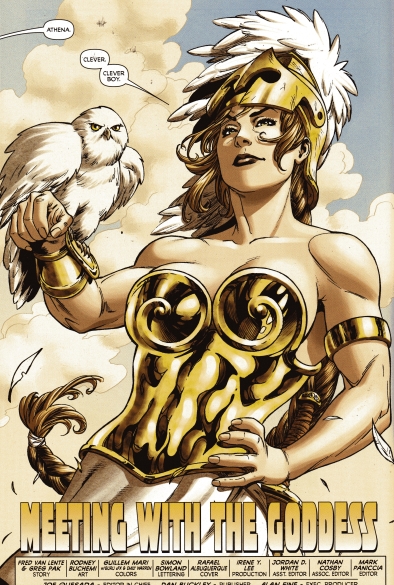
 ATHENA
 ATHENA
Real Name: Athena Parthenos
Identity/Class: Olympian god
Occupation: Goddess of wisdom, war, arts and crafts; advisor to Zeus
Group Membership: Olympian gods
Affiliations: Aegis (Trey Rollins), Avengers (Black Knight/Dane Whitman, Captain America/Steve Rogers, Captain Marvel/Monica Rambeau, Doctor Druid/Anthony Ludgate, Jocasta, Quicksilver/Pietro Maximoff, She-Hulk/Jennifer Walters, Spider-Man/Peter Parker, Spider-Woman/Jessica Drew, Sub-Mariner/Namor McKenzie, Thor/Odinson, USAgent/John Walker, Wasp/Hank Pym, Wasp/Janet Van Dyne, Wolverine/James "Logan" Howlett), Cadmus, Amadeus Cho, Council of Godheads, the Fates, Hercules, Horus, Inti, Izanagi, Jason, Namora, Odysseus, Pallas, Perseus; Enemies: Amazons (Artume, others), Amphisbaena, Apate, Arachne, Atlas, Avengers (Ares, Captain Marvel/Noh-Varr, Hawkeye/Bullseye, Iron Patriot/Norman Osborn, Ms. Marvel/Karla Sofen, Sentry/Robert Reynolds, Spider-Man/Mac Gargan, Wolverine/Daken), Chaos King (Mikaboshi), Cronus, Dolos, Pythagoras Dupree, Eternals, Gigantes, Delphyne Gorgon, Gorgons (Euryale, Medusa, Stheno), Vali Halfling, Huntsman, Hypnos, Kyknos, Nyx, Oizys, Pluto, Skrulls, Titans, Typhon; Known Relatives: Zeus (father), Metis (mother), Gaea
(great-grandmother), Ouranos (great-grandfather, deceased), Cronus, Rhea
(paternal grandparents), Oceanus, Tethys (maternal grandparents), Chiron, Pluto,
Neptune (uncles), Apollo, Ares, Dionysus,
Hephaestus, Hercules, Hermes
(half-brothers), Venus,
Artemis, Eileithyia, Eris,
Hebe, Persephone
(half-sisters), Demeter, Hera,
Vesta (aunts), Alex Aaron, Cupid,
Hermaphroditus (nephews), Aeneas (nephew, deceased), Harmonia (niece) Aliases: Minerva, Miranda Minerva, Pallas Athena, Athena Panhellenios, Agent
Sexton, Virgin Goddess Base of Operations: Olympus; on Earth, a country home in
the green mountains of Vermont First Appearance: (Atlas) Venus#11 (November, 1950) (see comments); (Marvel) Thor I#164 (May, 1969) Powers/Abilities: Athena possesses the conventional powers of the
Olympian gods including superhuman strength, the inability to age upon reaching
adulthood, immunity to terrestrial diseases and harm from conventional means and
a regenerative ability that heals wounds rapidly should she indeed be injured.
Athena is stronger than the average Olympian goddess (Class 25) and can lift
about 35 tons optimally. Athena wields certain magical abilities which allow her
to fly at great speed, change her size or form to appear as another person,
animal or object, render herself and other beings invisible from mortal eyesight
(for example when she was a secret participant in the Trojan War), create
illusory images, animate inanimate objects, and control the shape and form of
objects or people (notably she changed the physical appearance of Trey Rollins,
the New Warrior youth aka Aegis). Athena can also project mystical energy
bolts, cross the distance between dimensions and materialize objects. As the goddess of wisdom, Athena has devoted a great deal of
time throughout the centuries to studying and mastering many areas of knowledge
including all fields of non-technical science. Also, as the goddess of battle
Athena is quite adept at combat both armed and unarmed and is a highly competent
military strategist even superior to her half-brother Ares, the god of war. She
is a master of the weapons used at the time of ancient Greece and Rome including
the sword, spear, and shield. Height: 5'10" History: (Incredible Hercules#128 (fb) - BTS) - Athena punished her then-beautiful priestess Medusa Gorgon for consummating her passion with
Poseidon on her altar. From this day on Medusa and all her descendants were cursed. (Avengers: No Road Home#4 (fb) ) - Athena joined the Olympians' battle against Nyx and her children Hypnos, Apate and Dolos when they turned on the other Olympians. Athena battled Hypnos and aided the Olympians defeat Nyx and her children, who were afterward exiled into a prison of eternal darkness. (Official Handbook of the Marvel Universe Deluxe Edition#9) - Zeus discovered
Olympia, home to the superhumanly long-lived offshoot of humanity known as the
Eternals which resided near the gods' home of Olympus itself. Olympia was the
capital city of the Eternals and was ruled by Zuras. Zeus and Athena then
traveled to Olympia to meet with Zuras and his daughter Azura, named after her
father. Athena noticed the physical resemblances between Zeus and Zuras and
herself and Azura and hence suggested a pact of non-interference between the two
races where the Olympian Eternals would act as the gods' heralds on Earth at
certain times. The pact was sealed and Azura changed her name to Thena to honor
the pact. However, during the centuries that followed, many human worshippers of
the gods mistook several Eternals for the gods themselves. For example, Cybele
was mistaken for Gaea and Rhea, Helios for Apollo, Hero for Heracles (Hercules),
Makkari for Mercury/Hermes, Phastos for Hephaestus, Thena for Athena, and Zuras
for Zeus, etc. This led to a great resentment by the gods for their Eternal
representatives.
(Incredible Hercules#140 (fb) ) - Married to Aphrodite under direction of
their mother, Hera, Hephaestus immediately realized she only had eyes for Ares.
Hephaestus was himself impressed with Athena, who he felt was wise enough to see
past his physical flaws.
(Incredible Hercules#127 (fb) - BTS) - Athena slew a
chimera at Lycia.
(Incredible Hercules#127 (fb) - BTS / Incredible Hercules#140
(fb) ) - From this chimera's hide, Hephaestus forged for Athena his greatest
work, the Aegis breastplate. He thought once she saw the gift she would open her
heart to him, but when he threw himself at her, she punched him to the ground
and departed.
(Incredible Hercules#126 (fb) ) - As a youth, Teiresias, spied
Athena bathing, and the virgin goddess struck him blind to protect her modesty.
Teiresias' mother, a nymph, begged Athena to undo the curse, but Athena instead
opened Teiresias' ears so that he might hear the whispers of the gods. Teiresias
became a great prophet.
(Incredible Hercules#127 (fb) - BTS / Greco-Roman
myth) - Arachne
was a vain woman who considered her weaving ability greater than that of
Athena's. To resolve the matter, a competition was declared between the two
where they would weave tapestries. Arachne created a tapestry that depicted
events that happened in the lives of the gods (including several less-than-proud
moments) and Athena, consumed with rage and
jealousy at Arachne's handiwork, tore Arachne's tapestry apart causing the girl
to flee and subsequently commit suicide in her grief. As penance for her
actions, Athena cast a spell over Arachne and transformed her into a spider,
preserving her life and allowing her to spin and weave via the natural abilities
of a spider until the day she died in her new form.
(Incredible Hercules#126 (fb) ) - Many people, such as the Thebans, placed
weapons in the temples of gods such as Athena as offerings for past victories.
(Incredible Hercules#130 (fb)
- BTS) - Prophesying that the gods would one day be attacked by monsters that
could only be slain by a mortal bearing the lion's sign, Athena arranged for
Zeus to father Hercules, a savior for the world of gods and men from monsters
and fearsome giants when they would rise in revolt against Heaven. (Incredible Hercules#126 (fb) - BTS) - Athena arranged for Alcmene to leave
her baby, Alcaeus (later Heracles and Hercules) on a certain path. (Incredible Hercules#126 (fb) ) - Athena led Hera along that Earthly path to
find the young infant Alcaeus. Not knowing the infant's identity, Hera accepted
Athena's suggestion to suckle the infant. Hera did so until the infant bit down
onto her bosom with inhuman power, at which point she hurled him away from her;
her divine breast milk allegedly granted the infant virtual
invulnerability...and also led the boy to be renamed Heracles ("The Glory of
Hera"). (Incredible Hercules#126 (fb) - BTS) - Teiresias told Alcmene and Amphitryon
how Zeus was Heracles' true father. (Incredible Hercules#133 (fb) - BTS) - Athena guided Hercules to destroy the
invulnerable-skinned Nemean Lion by strangulation. (Hercules: Fall of an Avenger#2 (fb) ) - When Hercules, after his Twelve Labors, joined with Athena and declared war on King Augeas of Elis, Pluto, Neptune, Ares, and other gods went to war with him.
(Avengers: No Road Home#1 (fb) ) - Athena joined battle against the gigantic two-headed serpent Amphisbaena alongside Artmies, Hercules, Hermes, Neptune and Zeus. They vanquished the monster. (Incredible Hercules#130 (fb)) - As Gaea's gigantes children assaulted
Olympus, Athena traveled to Earth and summoned Hercules to help fight them.
Athena participated in the fierce struggle in which, with Hercules' help the
Olympian gods defeated the Gigantes. (Incredible Hercules#126 (fb) ) - Hera and Athena watched Hercules help Thebes defeat Minyan armies. Athena didn't mind that the humans used temple offerings to fight the Minyans. (Incredible Hercules#116 (fb)/Dark Reign: Ares#2 (fb) ) - When Hercules clashed with Ares' son Kyknos, Athena and Ares asked the
Moirae (Fates) if Hercules would best him. They replied that Hercules would slay Kyknos unless he were killed first. Ares intervened on the battle to assist his son, but Athena came to Hercules' aid in order to level the playing field;
her intervention allowed Hercules to break Ares' leg, forcing his retreat.
Ultimately, Hercules slew Kyknos. (Thor Annual I#8) - Athena also participated in the Trojan War which occurred from 1200 B.C. to 1190 B.C.,
taking the side of the Greek warriors against the Trojans to avenge, at least in
her mind, an insult performed on her by the Trojan prince Paris. Paris had
deemed Venus as the most beautiful goddess of all after a contest was formed
among Venus, Athena and Hera to be judged as "the most beautiful". During the war, Athena fought against
Ares, and empowered Prince Argive so that he could strike Ares a near-mortal wound.
(Incredible Hercules#127 (fb) - BTS) - Athena's Aegis pushed the Achaeans
into the sea during the battle for Troy.
(Incredible Hercules#141 (fb) ) - Athena mocked Zeus when he and the other Olympians fled from Typhon and hid in Egypt as animals. Athena's mocking drove Zeus back into battle with Typhon. (Thor Annual#5) - Athena observed as Hercules attempted to convince Zeus to wage war on Asgard. Ares confided to her that he hoped Hercules would be successful.
(Venus#11) - An unidentified goddess (resembling Athena) was present when Venus asked Jupiter for a way to save humanity from destruction. He told her about Michael Templar. (Incredible Hercules#137 (fb)) - In the guise of Miranda Minerva, Athena
wrote the book "The Heroes Journey," which detailed many of the connections
between myth and reality.
(Incredible Hercules#137 (fb) ) - Decades ago,
Athena, as Miranda Minerva, ran an orphanage in upstate New York's, Mount
Athena. She had all of her students undergo intelligence tests. The young
Pythagoras Dupree scored the best on these tests and was her favorite, leading
the other orphans to beat him up. When Dupree's idol, Master Mind Excello,
vanished mysteriously, Dupree was distraught, and he fled the orphanage.
(Incredible Hercules#137 (fb) ) - After Dupree had made a killing in the stock markets by his ability to
predict trends and bought the Excello Soap Company and the company town, Athena
appeared to him in her true form. She told him she needed someone with a
hypermind like his for a great task (to oppose the likes of Mikaboshi), noting
that while she had used heroes of strength in the past, she needed a hero of the
mind. Dupree told her he'd have to think about it.
(Incredible Hercules#137 (fb)
- BTS) - When Athena returned to Excello, Utah, Dupree blew up the whole town,
hoping to take her with it. He then hid out within the labyrinth of bubble
realities he had created.
(Incredible Hercules#137 (fb) - BTS) - Realizing
Athena might find others with hyperminds who might lead her to him, he began
using his company to sponsor tests, lure the winners to Excello, Utah, and then
kill them.
(Incredible Hercules#137 (fb) - BTS) - Realizing she had put too
much on Dupree too quickly, Athena decided her new champion would need a
different sort of mentor than her.
(Thor I#164) - Athena stood alongside Zeus as he forbade Pluto from working on Earth. (Champions I#2) - Athena observed Pluto's conflict with Zeus. (Thor I#289) - Athena accompanied Zeus to a meeting with Odin, as he requested their aid in opposing the Eternals. (Thor I#291-292) - Athena participated in the assault upon the Eternals' home city, Olympia, and fought her one-time impersonator Thena. The battle with the Eternals soon
ended, and Athena withdrew with the other Olympians. (Wolverine/Hercules: Myths, Monsters & Mutants#1 (fb) ) - Wolverine caught the attention of the Olympians gods. One day Athena and the other gods of Olympus watched him fight agents of the Hellfire Club (around the time of the Dark Phoenix saga). (Hulk vs. Hercules: When Titans Collide#1 (fb) ) - Athena and Ares went tracking a pair of giants who had caught a Calydonian boar they had been hunting. Finding the Hulk in the giants' midst, Ares provoked a fight on him which led to the Hulk invading Olympus before Hercules fought the Hulk to a standstill. Athena advised Hercules that the Hulk was not malevolent, then joined her fellow gods in battling the giants as they released Cronus from Tartarus.
(Avengers I#283-284) - Athena observed as Hephaestus attempted to lift Thor's hammer, Mjolnir, but they were interrupted by the arrival of the Avengers at his workshop.
Athena fought with Thor, but their battle ended when he saved her from a pool of molten metal. Realizing that the Avengers were not, as Zeus had claimed, enemies of Olympus,
Athena convinced Hephaestus to hear them out, and then accompanied them with Hephaestus and Venus to visit Hercules, in an attempt to heal him. However, they were found at Hercules'
bedside by Zeus, who blasted all of them with his lightning. Athena and the other Olympians who had allied themselves with the Avengers took awhile to recover, as Zeus's fury had
been even greater against them.
(Avengers I#285) - Athena was present as Zeus forbade all Olympians from interfering with the earth. (Incredible Hercules#127 (fb) - BTS) - As one of her 97 simultaneous plans to
save the world she runs at any given moment, Athena laid her Aegis breastplate
in the path of Trey Rollins of Brooklyn, who became the super hero Aegis. (New Warriors II#10) - Athena appeared to Trey Rollins and revealed to him that she was his
patroness and had chosen him to bear the breastplate Aegis as her new champion,
carrying on the tradition of past heroes of ancient Greece including Achilles, Jason, and Odysseus. (Hercules III#4 - BTS) - Athena was presumably present with the Olympian pantheon as they convened a board meeting on Earth at the Olympus Group, assuming the appearances of mortal businessmen in an attempt to maintain some connection with humanity. Zeus had gathered them to confront Hera for manipulating Hercules into appearing on a reality television show as part of an attempt to gain revenge upon him, but he wound up being jeered at by his own family for his many infidelities. They finally voted against interfering with Hercules' labors.
(Ares#1) - After a battle with Pluto, Athena met with the other gods of Olympus as they discussed how distasteful Ares' brutality was to them.
(Ares#3) - Athena fought for Olympus as it was invaded by Japanese demons led by Mikaboshi, and looked to Ares for strategy on the battlefield.
(Ares#5) - Athena joined the Olympians in their last battle against Mikaboshi's forces. Aided by benevolent gods of the east, the Olympians prevailed.
(Incredible Hercules#137 (fb) ) - Posing as a cute teenage girl in Tucson,
Arizona, Athena distracted Amadeus Cho on his way home from school after winning
the Excello Soap Company's Brain Fight. The ten minute delay prevented Amadeus
from being in his house when Dupree's agents blew it up, though he was close
enough to witness (and be knocked back by) the explosion.
(Amazing Fantasy
II#15 (fb) / Incredible Hercules#133 (fb) - BTS) - In the guise of government
agent Sexton, Athena contacted Amadeus Cho just after his house had been blown
up (secretly by agents of Pythagoras Dupree). She told him that "the enemy" had
done it and wanted to use Cho to destroy "the world as we know it." (Incredible Hercules#117 (fb) - BTS) - Following the Olympian Diaspora,
Athena traveled to Earth and took a job as a security consultant for the Atlas Foundation. (Incredible Hercules#117 (fb) - BTS) - At Atlas, Athena uncovered
a Skrull imposter, obtained information from him regarding the nature of the
Skrull's religious war, and then decapitated him.
(Incredible Hercules#115) - Just as Hercules and Amadeus arrived at Athena's Vermont home, she informed them that they would soon be back in combat because she had forseen a coming conflict.
(Hulk vs. Hercules: When Titans Collide#1) - Athena related the story of Hercules' battle with the Hulk and Cronus to Amadeus in order to teach him that Hercules could be as monstrous as the Hulk.
(She-Hulk II#30) - Athena and Amadeus Cho picked up Hercules after She-Hulk tossed him out of her trailer following a wild night. Hercules asked Athena and Cho if they thought She-Hulk would call him. They were both sure she won't. (Incredible Hercules#116) - Athena brought Hercules and Amadeus to San Francisco where the Dreaming Celestial resided for a conference of the Council of Godheads/Council
Elite to be held in the creature's shadow concerning a Skrull invasion. En
route, she quizzed Amadeus to evaluate his knowledge, advised him to use his
intelligence the right way, and told him that the first step towards
understanding that is understanding that intelligence is really pattern
recognition. She further told him that he needed to be able to recognize
patterns in himself or would likely come to impose patterns where there are
none. (Incredible Hercules#117) - Athena identified the threat of the Skrulls to her fellow gods and announced that Hercules would lead the assemblage of gods to confront the Skrullian gods.
However, a number of the other Pantheons, as voiced by Anansi for the Vodu,
suspecting she was trying to get them to send away their strongest members so
the homeless Olympians might invade and conquer them. (Incredible Hercules#120) - At the conclusion of the gods' assault upon the Skrulls, the Skrull gods were left for dead, with Mikaboshi set loose and vowing revenge. Observing all of this from Earth, Athena seemed pleased with Mikaboshi for some enigmatic reason.
(Incredible Hercules#127 (fb) - BTS) - Partially due to Athena convening the
Council of Godheads without consulting her, Hera reduced Athena's shares in the
Olympus Group from controlling to minority status. She also relieved Athena of
her seat on the board. (Incredible Hercules#121) - While Amadeus kept his
distance as Hercules romanced Namora, Athena called him, telling him to get some
rest so his brain was in fighting shape, and also advised him to focus on
brotherly love over romance.
(Incredible Hercules#123) - Hercules called Athena to tell her that the Amazons were on their way to the Omphalos. Athena explained to Hercules that they
wouldn't be able to use it before they brought it to the current Axis Mundi in Washington DC. (Incredible Hercules#125) - After Delphyne Gorgon, one of the Amazons, killed Artume reality was restored. Athena stood by and then used the
remaining energies in the Omphalos to fix the damages in Washington. (Incredible Hercules#127) - Athena, Hercules and Amadeus had a coffee at Silly's Greek Diner,
and she questioned their need to serve in the Wasp (Henry Pym)'s Avengers when
they had so much other stuff they needed to do. Hera and Typhon
confronted them there, but, due to the diner's protection by the Furies, Hercules couldn't fight Hera and Typhon. In a heated argument between Hera and Athena concerning Athena representing the Olympians during the Skrull crisis at the Council of Godheads, Hera got really angry and then left after
threatening to kill her and Amadeus, and implying that Athena's agent Aegis was dead. Athena, Hercules and Amadeus soon found Aegis' corpse at the Excello Soap Company where Hera and her allies
(Delphyne Gorgon, Huntsman, Pluto, Typhon) were already waiting for them. Their upcoming fight was interrupted by Osborn's Avengers
(Ares, Captain Marvel/Noh-Varr, Hawkeye/Bullseye, Iron Patriot, Ms.
Marvel/Moonstone/Karla Sofen, Sentry, Spider-Man/Venom/Mac Gargan, Wolverine/Daken). (Incredible Hercules#128) - Athena, Hercules and Amadeus fought against Osborn's Avengers and Hera's allies.
Athena was initially stunned by a grenade thrown by Ares, and after recovery was disgusted by Spider-Man (Gargan)'s
web-net. When she decided that they had to leave, she disturbed Cho by his
refusing to retrieve Rollins' corpse -- "Retrieving it gains us no tactical
advantage. And if he'd been an effective champion, he'd still be alive." (Incredible Hercules#129 (fb) - BTS) - During the above struggle, Hera's
forces recovered the Aegis. (Incredible Hercules#129) - After guiding Hercules and Amadeus
to wash away their sins in the waters of the Jersey Shore, Athena led them to the Stygian Casino,
which contained a portal to Hades, through which they were to rescue Zeus. She didn't join them on their mission. (Incredible Hercules#131) - As Hercules, Zeus, and then Cho
exited the Stygian Casino, Athena was shocked when she learned that Zeus had drank from the river Lethe and witnessed his return to Earth
in the form of a mostly amnesiac youth. Seeking a place to hide Zeus until they
could figure out their next move, Athena suggested Asgard, but Hercules decided
to go to the Avengers instead. When Cho, angry with both Athena and Hercules,
departed to seek out his missing sister (whom he had just learned about), Athena
told Hercules to let him go. (Incredible Hercules#132) - As Athena drove Hercules and Zeus by car to seek
out the Avengers, they were attacked by Harpies sent by Hera to destroy them.
Athena leapt out of the car and engaged the Harpies, allowing Hercules to
continue his journey to bring Zeus to the Avengers for protection. (Incredible Hercules#133) - As Cho investigated the former town Excello,
Athena (in the form of agent Sexton) approached him again, warning him against
talking to a manifestation of Pythagoras Dupree and informing him how numerous
geniuses had vanished after being summoned to Excello to win prizes from winning
intelligence competitions. Both Cho and "Sexton" were subdued by Dupree's
"Boltzmann Brains." (Incredible Hercules#135) - With Dupree's "Bubble Reality," Cho freed "agent
Sexton" and then led the two of them to escape the bubble reality and see the
destroyed town for what it is. Cho then revealed he had discovered Sexton's true
identity, and Athena assumed her true form. (Incredible Hercules#137) - Athena responded to Cho's accusations of not
saving his family when she knew what was going to happen, telling him the gods
only provide signposts, rather than giving direct instruction. She further
welcomed Cho to tell Hercules that Herc had been training the person Athena
intended to be his replacement. As he departed to confront Dupree, Athena told
him that he was fortunate to have someone to blame for his parent's death...most
people could only blame the gods. (Incredible Hercules#138 (fb)) - Athena told Cho
that he would be the next "Prince of Power," predicting that Hercules would
perish in the coming battle. (Incredible Hercules#139 (fb)) - Delphyne
Gorgon
allied with Hephaestus to design a helmet that would restore her Gorgon
petrifaction powers in exchange for allowing Hephaestus to have Athena once she
was petrified. (Assault on New Olympus Prologue#1) - Athena and Cho met with Aphrodite,
seeking her aid against Athena's Continuum plot. Disinterested, Aphrodite
offered to assist if Athena helped her defeat the Agents of Atlas. Athena
refused to help Aphrodite prosecute her jealous rivalries, and Aphrodite
likewise refused to aid Athena. (Incredible Hercules#138 (fb) - BTS) - Athena
provided Aphrodite with a tiny favor against the Agents of Atlas, and in return,
Aphrodite agreed to seduce Ares to distract him from aiding Hera. (Assault on New Olympus Prologue#1 (fb) - BTS) - Apollo refused to aid Athena
as well, preferring to "wait and see." And Dionysus was too drunk to even see
her. (Assault on New Olympus Prologue#1) - Reasoning that Artemis would do
whatever Apollo did, Athena decided they could only count on Hercules. Seeing
Hebe working for FEAST, Cho and Athena called Avengers Infinite Mansion,
learning from Jocasta that Hercules had not arrived there with Zeus, just
seconds before Hercules arrived and told Jocasta to tell Athena they had gotten
there a few days ago. Athena sent Hercules to find Hebe, who had inside
knowledge of Hera's schemes. (Incredible Hercules#138) - Joined by the Wasp (Hank Pym)'s assembled
Avengers (Jocasta, Quicksilver, Spider-Man, Spider-Woman, USAgent, Wasp,
Wolverine), Hercules, Athena, Zeus, and Cho discussed Hera's Continuum plot.
Athena calmed young Zeus when he became irate over USAgent denouncing the gods
as nothing more than superhumans like himself. Athena further shared how many of
the heroes were like modern incarnations of the gods of old. Cho's plan had Hebe
pose as a decoy to seemingly smuggle their forces into the Olympus Group then
really smuggled them in inside an ambulance summoned to help Hebe after Hera
struck her down. When Hera summoned her forces -- Arachne, Argus, Delphyne
Gorgon, Eris, Huntsman, Lamia, Typhon -- and announced that Ares would soon be
there to lead them to victory, Athena revealed she had sent Aphrodite
to...distract Ares. Soon after, however, Thanatos arrived, noting that one of
them would die before the battle's end. (Incredible Hercules#139) - While chastising Cho for trying to save Hercules,
which was distracting him and increasing the chances of his demise, Athena was
struck down by a blast from behind by Hera. Recovering and protecting herself
with her shield from Hera's continued blasts, Athena was again distracted when
Typhon snatched the young Zeus and escaped with him alongside Hera into an
Adamantine passage. As she ordered the others to stop Typhon, she was punched to
the ground by Delphyne Gorgon, who then donned her Hephaestus-designed helmet,
which turned Athena to stone. (Incredible Hercules#140) - Hephaestus' automata captured the petrified
Athena and brought it to Hephaestus' forge. As Delphyne Gorgon (who had been
turned human by neutralizing Athena and thus her curse) watched on, Hephaestus
began pouring a mold around her form, intending to use it to create a gold
automaton in the exact likeness of Athena, whom he still desired. Delphyne soon
turned against Hephaestus, unable to let any woman be so taken advantage of, but
the Continuum was then initiated, and they were distracted as much of existence
began to fade. (Incredible Hercules#141) - Zeus' thunderbolt flew to Athena's hand after Typhon killed Zeus making her the new leader of the Olympians. Athena sent Hercules to the Continuum chamber to shut down Continuum. She then approached Delphyne Gorgon to punish her for her attempt to assaniate Athena. She stripped Delphyne of the throne of the Amazons and banished her to the bowels of Olympus, but Delphyne didn't care. Athena entered the Continuum chamber after Hercules had killed Typhon. With tears in her eyes she explained to Hercules that only one Prince of Power could exist and that she needed Amadeus as her new champion. Athena destroyed Continuum seemingly killing Hercules, who was still on the other side of the portal when it exploded. When the Avengers, Hebe and Amadeus arrived in the Continuum chamber Athena told them that Hercules had sacrificed himself to safe their world.
(Hercules: Fall of an Avenger#1 (fb) ) - Amadeus Cho saw Athena smile when she left after Hercules' death.
(Hercules: Fall of an Avenger#1/2 (fb) ) - Athena asked Venus, the new goddess of love (the Naiad), to close out Hercules' many businesses and incorporate his forgotten holdings into the Olympus Group. Venus took the job.
(Hercules: Fall of an Avenger#1) - At the Parthenon in Athen Amadeus called out Athena. He was joined by several of Hercules' allies until Athena led the Olympus Group including Apollo to the funeral of Hercules. Athena explained to Amadeus that they now had to decide who their new leader would be. She ordered everyone to leave except for Amadeus, who she chose as the new leader of the Olympus Group.
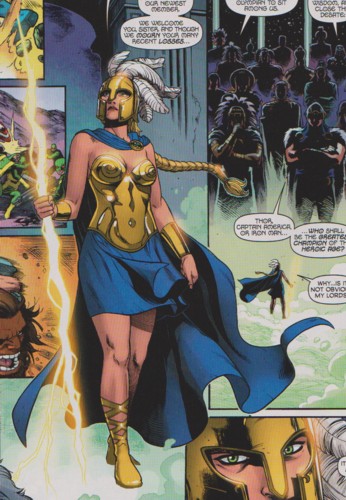
(Hercules: Fall of an Avenger#2) - Athena declared herself leader of the Olympian Gods and Amadeus leader of the Olympus Group, but some of the other gods including Apollo, Artemis and late arrival Nyx were against her decisions. The gods decided to let mortals battle for their cause. Athena chose Amadeus Cho as her representative, but the battle between the mortal proxies ended in a draw when they stopped fighting and attacked the gods themselves. Athena overpowered Amadeus, who didn't want to accept his destiny and left. (Heroic Age: Prince of Power#1) - The Council met to discuss who would be the greatest hero of the heroic age. Captain America, Iron Man, and Thor were proposed by some, and Athena told them with certainty that it was Amadeus Cho. She wasn't pleased when Amadeus underminded her pitch as him as a new kind of champion of the mind when he beat up Griffin with brute force.
(Heroic Age: Prince of Power#2) - When Vali Halfling of the Pantheon extinguished the Promethean Flame that granted Olympians their immortality, Athena screamed in pain. She was comforted by Izanagi. Threatened by Vali's threat to attain everything he needed to gain full omniscience all Council members returrned to their respective realms, including Athena, who didn't want to participate in any more discussions about the matter because she felt too ill.
Upon her return to the Olympus Group she was caught by Vali and his soldiers and imprisoned in her own headquarter alongside Hebe, who had both grown old due to the abscence of the Promethian Flame.
(Heroic Age: Prince of Power#3) - Delphyne Gorgon found Athena sitting in her cell and made fun of her. Athena pleaded her to bring nectar to Hebe and her because otherwise they would die of old age. After defeating some of the guards Delphyne gave Athena, as requested, one of their headsets.
(Heroic Age: Prince of Power#4) - Using the headset Athena stayed in contact with Delphyne and told her how to reach the roof from where she could reach the Promethean Flame and the nectar. Athena and Hebe regained their youth when the Promethean Flame was reignited.
(Chaos War#2 (fb) - BTS) - Athena fled upon Hercules' return. (Chaos War#3 (fb) - BTS) - Athena allied with the Chaos King (Mikaboshi) and aided him with her wisdom to absorb the powers and realms of Nightmare and all of Earth's Pantheons. (Chaos War#3) - When the Chaos King (Mikaboshi) lost the "God Squad", Thor, Hercules and Amadeus Cho inside his own growing vastness Athena reminded him that Hercules and Cho were the only true threats. She then reminded the Chaos King that she was his greatest srevant and that he was only able to come this far because of her wisdom. (Chaos War#4) - Athena tried her best to convince the Chaos King that he still needed her wisdom. She revealed that convincing the Japanese gods to release Mikaboshi and him destroying the universe was all part of her plan because eventually order will reemerge and existence will get a second chance. She knew Mikaboshi had absorbed too much too quickly and couldn't even find his enemies anymore. The Chaos King had enough of her prattling, infected her with his darkness and dragged her inside himself to send her after Hercules. Athena teleported out of nowhere into the Halemaumau Crater where the last remaining gods of Earth were meeting. She attacked Hercules, justifying her past actions (sending him to Continuity) as a mere attempt to exile Hercules and not kill him, but now was different because her master the Chaos King had already started his final attack on reality. Athena was sure Hercules would fail to stop the Chaos King. She attacked Hercules once again after Gaea and Pele taught him how to recreate himself and he easily destroyed her. (Chaos War#5) - After the Chaos King was trapped in Continuum Athena congratulated Hercules for saving creation. She had apparently survived their last encounter and was glad that Hercules had finally become the hero she always wanted him to be. Realizing that everything until now was set up by Athena, who didn't care how many had died, Hercules declined her offer to become the new All-Father of Olympus. She warned Hercules not to use his powers until he had healed up, but Hercules didn't care and spent all his godly powers to recreate everything that was destroyed during the war with the Chaos King. SECRET WARS III HAPPENED (Civil War II: Gods of War#4 (fb) - BTS) - Like all old gods Athena was influenced by the foul power of the new gods known as the Uprising Storm. Athena's ability to interact with the real world was interrupted and she was rendered silent, immaterial and visible only to Hercules whenever she tried to appear on Earth. (Hercules IV#1) - Athena appeared to Hercules after battle with Urmut. Athena stayed silent and only Hercules could see her. He wondered why she didn't speak to him and wondered if he had offended her. (Hercules IV#2) - Athena appeared to Hercules in a playground. She once again stayed silent and was only visible to him. He told her that she was once again her champion and was trying his best to regain his status and purify his reputation. Hercules grew angry with Athena when she remained silent and punched the apparition, which disappeared when his fist connected. (Hercules IV#3) - Athena silently watched Hercules as he learned that Tiresias had been attacked. He tried to confront her, but she ignored him and was only visible to him. (Hercules IV#4) - Athena watched Hercules arrive at a construction site in Queens in search for Gilgamesh. Hercules was sure she was not there to help and ignored her. (Hercules IV#5) - Visible only to Hercules Athena watched him get attacked by Catastrophobia, a member of new gos known as the Uprising Storm. Hercules believed she was there to see him die, but she remained silent. (Civil War II: Gods of War#4) - After Hercules and his allies defeated the Uprising Storm Athena once again appeared to Hercules and told him how the Uprising Storm had interfered with her abilitiy to communicate with him before. She thanked Hercules for defeating the Uprising Storm and offered him a place in Olympus once again, but Hercules declined because in his opinion his work as a hero on Earth had just begun. (Avengers: No Road Home#2 (fb) ) - Nyx and her children Apate, Dolos, Hypnos and Oyzis attacked the Olympian gods, including Athena, on Mount Olympus. (Avengers: No Road Home#1) - After Hercules arrived with the Avengers on Mount Olympus he found Athena trapped under a column. She died in Hercules' arms after revealing that Nyx was behind the attack on Olympus. Comments: Adapted by Stan Lee and Jack Kirby. According to Eternals II#6, Athens was actually named after Thena, when she was believed to be Athena. An alternate myth history of Athena's birth, plus some other info neither
confirmed or denied as yet in the MU. Of all of Zeus's numerous offspring, Athena has
always had the king of the gods favor above all others. This may be due to the
fact that Athena's personal interests have always diverged from those of the
other gods. Whereas most of the Olympian deities have focused their lives on
pursuing hedonism and are usually controlled by their passions and engage in
petty bickering amongst themselves, Athena's temperament has usually been more
humble in comparison and has always striven to pursue and act with knowledge and
wisdom. Athena was so favored by her father that she was the only god-child of
Zeus allowed to wear the Aegis, the magically-protective breastplate of Zeus.
The only other exception of Zeus's offspring wearing the Aegis was when his
mortal demigod son Perseus, by the human princess Danae, was allowed to use it
with Athena's blessing when confronting the Gorgon called Medusa.
(Greek-Roman myth) - Other encounters included her dealings with both mortal and demigod champions. Among
these included Perseus, her half-brother, whom she aided in his mission
concerning Medusa; Jason whom she aided in his quest for the magical Golden
Fleece and imparted to him a magical talking oak as an oracular guide attached
to his ship, The Argo; Cadmus whom she aided in slaying the dragon of Ares;
Odysseus (Ulysses) whom she aided in returning home to Ithaca from the Trojan
War and reclaiming his kingdom; and Heracles (Hercules), another half-brother of
hers whom she aided during the course of his legendary Twelve Labors. All these
heroes she aided in their various quests fulfilling her role as the goddess of
warriors, guiding and advising them in their adventures. Athena was one of the most beloved goddesses among the Grecian
peoples. So much so that the city known as Athens was named for her from its
original name of Attica and during the days of ancient Greece she was the
protector of its people. The naming of the city in Athena's honor took place
after she won a contest between her and her uncle, the sea-god Poseidon to
decide who would lay claim to the city. Poseidon gave the people a salty spring
to curry their favor but they ultimately chose Athena over Poseidon when the
goddess provided an olive tree that was more useful. Thus, she became the patron
goddess of Athens. Athena was also worshipped under the Latin name of Minerva
during the days of ancient Rome. An unnamed goddess wearing Athena's helmet appears in the Michael Templar Venus story. Gammatotem also pointed out that a character named Athene (another spelling of the Greek Goddess Athena) visited the descendant of Medusa in Medusa-Land, though it is unclear if it was another citizen of Medusa-Land or the goddess Athena herself. Profile by Alex K, Prime Eternal and Will Uchtman CLARIFICATIONS: images: (without ads) Appearances:
First Posted: 05/12/2003 Any Additions/Corrections? please let me know.
Non-Marvel Copyright info Special Thanks to www.g-mart.com for hosting the Appendix, Master List, etc.!
formerly Chaos King (Mikaboshi), Pythagoras Dupree
formerly Amadeus Cho, Hercules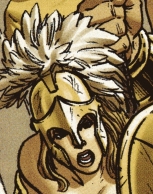
Weight: 440 lbs.
Eyes: Grey
Hair: Black
(Incredible Hercules#127 (fb) - BTS) - After Zeus impregnated the Titaness
Metis, the Fates foretold their child would be greater even than Zeus.
Presumably inspired by Cronus, Zeus ate Metis before she could give birth. Nine
months later, Zeus had a terrible migraine, and Hephaestus split open Zeus' head
with an axe to relieve the pressure. From this wound Athena emerged, fully grown
and armed as the goddess of wisdom and war.
Hera swore that one day Hercules would be slain by Ares and
that she would not forget Athena's role in this humiliation. Athena already had someone in mind to follow Hercules--Amadeus Cho.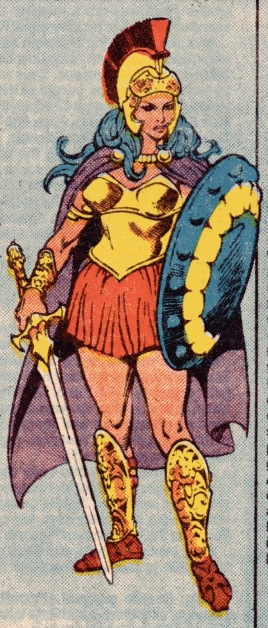 (Thor #124 - BTS / Incredible Hercules#137
(fb) ) - After observing Thor working side by side with the mortal Avengers,
Athena returned to Olympus and persuaded Zeus to send Hercules to Earth on some
vague open-ended "mission." She knew that the champions of two ages (Hercules,
her past champion, and her next champion, a hero of the mind) would be drawn to
each other like magnets of opposing polarity.
(Thor #124 - BTS / Incredible Hercules#137
(fb) ) - After observing Thor working side by side with the mortal Avengers,
Athena returned to Olympus and persuaded Zeus to send Hercules to Earth on some
vague open-ended "mission." She knew that the champions of two ages (Hercules,
her past champion, and her next champion, a hero of the mind) would be drawn to
each other like magnets of opposing polarity.
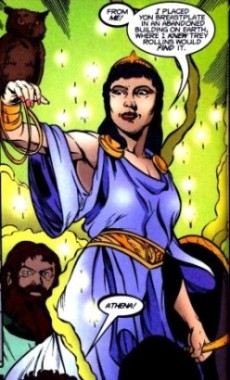
 (Incredible Hercules#113) - From her home in Vermont, Athena was contacted by Hercules who asked if he and his friend Amadeus Cho could hide with her. Athena warned Hercules that Ares was in pursuit of him and that the ascendance of the planet Mars would make him exceptionally tenacious. She also advised Hercules that Amadeus' powers could be made to serve good or evil and that Hercules must show him the path of a hero.
Upon Athena, Amadeus, and Hercules' arrival, the Eternals Ikaris and Thena wound up in a fight with Hercules when they mistook him for their comrade the Forgotten One.
Athena aided Hercules, assaulting Thena while Herc fought Ikaris. Thena gained
the advantage over Athena, but Amadeus struck Thena, causing him to blast it
him; Amadeus dodged, allowing the blast to strike the Dreaming Celestial, who
incapacitated her for the seeming assault. The fight was stopped when Makkari
revealed the error to the other Eternals and they departed peacefully.
Athena subsequently appeared before the Council of Godheads, revealing the
Skrulls' invasion.
She also passed on a prophecy from Urania to Amadeus: to help Hercules at his weakest by doing the hardest thing he had ever done. As they departed, the god Mikaboshi
wondered aloud if Athena's eyes had always been green, leading others to wonder
if she was a Skrull.
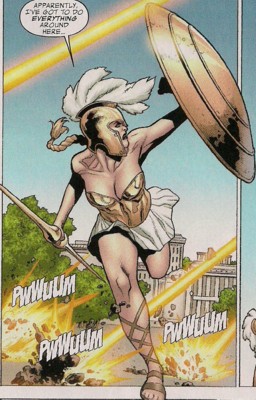 (Incredible Hercules#124) - Athena joined Namora and Hercules in Washington DC to stop Artume from using the Omphalus. Though they defeated Atlas, they failed to stop Artume, allowing her to create
the new reality-92124 with the Omphalus.
(Incredible Hercules#124) - Athena joined Namora and Hercules in Washington DC to stop Artume from using the Omphalus. Though they defeated Atlas, they failed to stop Artume, allowing her to create
the new reality-92124 with the Omphalus.
Hercules distracted the Avengers by attacking a cruise
ship, and Athena told Hercules and Amadeus to meet her later at the Stygian Casino.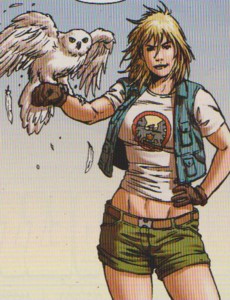
After Cho had manipulated Dupree into killing himself and
then discovered the secret of Continuum, Athena met with him again. He realized
she had been the young girl who had delayed his return home on the day of his
parent's death. Revealing something of her manipulations, Athena noted that Cho
had passed his initiation. Before she could begin preparing him for her true
mission, Cho revealed Continuum's true nature to him. They both realized they
needed to find Hercules ASAP.
Meanwhile, sensing both the growing threat of Mikaboshi and
that Dupree was dead and that Athena was gathering allies against her, Hera
prepared to unleash Continuum.
At FEAST, Athena was skeptical about their success given
Hercules' limited gathered forces ( Cho, Hebe, and young Zeus), after which
Spider-Man (Peter Parker), Spider-Woman (Jessica Drew) and Wolverine
(Logan/James Howlett) arrived.
Meanwhile, young Zeus convinced Hera he had changed much from
his experiences on Earth, and she ordered Typhon to power down Continuum. The
band that allowed Hera to control him somehow removed, Typhon refused. When Zeus
and Hera combined their powers to destroy him, the blast was reflected back at
Hera, blowing off her head, after which Typhon stripped off his shirt, revealing
he had donned the Aegis.
When Athena arrived next Monday at the Olympus Group Tower she couldn't enter it anymore. Hebe led her to Amadeus, who decided to take the job after all, but only to use all the resources Athena gave to him to find Hercules.
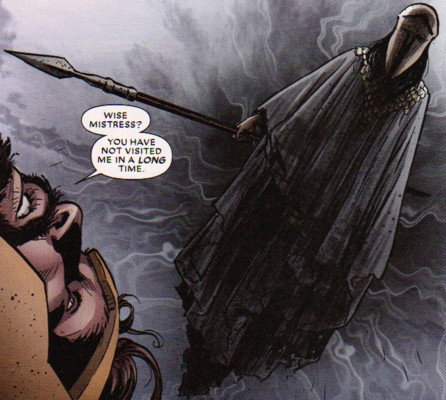
Will U:
Athena is the daughter of the
Olympian god-king Zeus and his first consort Metis, the goddess of prudence
who was the daughter of the Titan sea-deities Oceanus and Tethys. After
defeating the earlier generation of gods known as the Titans for the rule of the
dimension known as Olympus, Zeus chose to mate with the Titaness Metis
sometime prior to making his elder sister, Hera, his lawful wife and Queen of
the gods. Thus, Zeus's union with Metis resulted in Athena being born near Lake
Tritonis in Libya. Tritonis was controlled
by her cousin, the god Triton, a son of the sea-lord Poseidon. After Athena's birth however, Zeus was informed of a prophecy given by
his grandmother Gaea that Metis's second child by Zeus would be a god more
powerful than his father and who would replace him as ruler of the gods as Zeus
had done to his father Cronus who likewise had replaced his father Ouranos.
Hence, Metis exiled herself from Olympus to prevent the prophecy from coming to
pass. Raised by her elder cousin Triton, Athena befriended Pallas his daughter
who was similar in age to her. Athena accidentally killed Pallas during a bout
of simulated combat and thus annexed Pallas's name to her own in memory of her
fallen cousin. To this day she is sometimes called Pallas Athena.
--Gammatotem
--Markus Raymond
Athena should not be confused with:
Incredible Hercules#120, p24 (main)
Incredible Hercules138, p15, bottom left (head shot)
OHOTMU Deluxe Edition#9, Olympians sub-entry (handbook image)
New Warriors II#10, p4, pan5 (with Owl in blue dress)
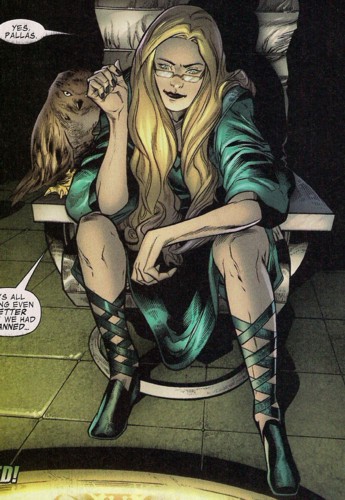
Incredible Hercules#120, p24, pan2 (with Owl on chair)
Incredible Hercules#124, p9, pan1 (with shield and spear)
Incredible Hercules#135, p20, pan4 (Agent Sexton)
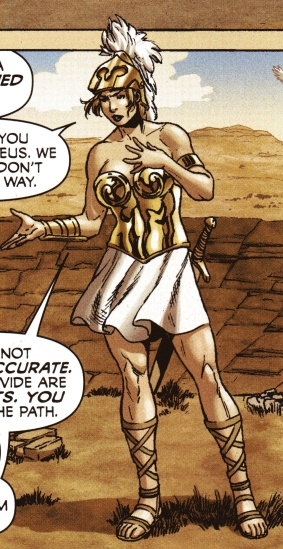
Incredible Hercules#137, p4, pan2 (in armor)
Heroic Age: Prince of Power#1, p2, pan1 (with Council of Godheads)
Hercules IV#1, p11, pan2 (dark and silent)
Venus#11 (November, 1950) - Werner Roth (artist), Stan Lee (editor)
Thor I#164 (May, 1969) - Stan Lee (writer/editor), Jack Kirby (pencils), Vince Colletta (inks)
Thor Annual#5 (1976) - Steve Englehart (writer), John Buscema (pencils), Tony DeZuniga and friends (inks), Archie Goodwin (editor)
Champions I#2 (January, 1976) - Tony Isabella (writer), Don Heck (penciler), John Tartaglione (inker), Marv Wolfman (editor)
Thor Annual#8 (1979) - Roy Thomas (writer/editor), John Buscema (pencils), Tony DeZuniga (inks)
Thor I#289 (November, 1979) - Roy Thomas (writer), Keith Pollard (pencils), Chic Stone (inks), Jim Shooter (editor)
Thor I#291-292 (January-February, 1980) - Roy Thomas (writer), Keith Pollard (pencils), Chic Stone (#291) & Bob Layton (#292) (inks), Jim Shooter (editor)
Official Handbook of the Marvel Universe Deluxe Edition#9 (August, 1986)
Avengers I#283-285 (September-November, 1987) - Roger Stern (writer), John Buscema (pencils), Tom Palmer (inks), Mark Gruenwald (editor)
New Warriors II#10 (July, 2000) - Jay Faerber (writer), Jamal Igle (pencils), Walden Wong (inks), Bobbie Chase (editor)
Hercules III#4 (September, 2005) - Frank Tieri (writer), Mark Texeira (penciler), Jimmy Palmiotti (inker), Axel Alonso (editor)
Ares#1 (March, 2006) - Michael Avon Oeming (writer), Travel Foreman (penciler), Derek Fridolfs (inker), Warren Simons (editor)
Ares#3 (May, July, 2006) - Michael Avon Oeming (writer), Travel Foreman (penciler), Derek Fridolfs (inker), Warren Simons (editor)
Ares#5 (July, 2006) - Michael Avon Oeming (writer), Travel Foreman (penciler), Derek Fridolfs (inker), Warren Simons (editor)
Incredible Hercules#113 (February, 2008) - Greg Pak, Fred Van Lente (writers), Khoi Pham (penciler), Paul Neary (inker), Mark Paniccia (editor)
Incredible Hercules#115 (April, 2008) - Greg Pak, Fred Van Lente (writers), Khoi Pham, Rafa Sandoval (pencilers), Paul Neary, Roger Bonet (inkers), Mark Paniccia (editor)
Hulk vs. Hercules: When Titans Collide#1 (June, 2008) - Greg Pak, Fred Van Lente (writers), Khoi Pham, Paul Neary, Dennis Calero, Eric Nguyen, Reilly Brown, Carlos Cuevas, Terry Pallot, Chris Sotomayor, Bob Layton (artists), Mark Paniccia (editor)
Incredible Hercules#116-117 (June-July, 2008) - Greg Pak, Fred Van Lente (writers), Khoi Pham, Rafa Sandoval (pencilers), Paul Neary, Roger Bonet (inkers), Mark Paniccia (editor)
She-Hulk II#30 (August, 2008) - Peter David (writer), Val Semeiks (pencils), Victor Olazaba (inks), Bill Rosemann (editor)
Incredible Hercules#120 (October, 2008) - Greg Pak, Fred Van Lente (writers), Rafa Sandoval (penciler), Roger Bonet, Greg Adams (inkers), Mark Paniccia (editor)
Incredible Hercules#123-125 (January - March, 2009) - Greg Pak & Fred Van Lente (writers), Clayton Henry & Salva Espin (artist), Mark Paniccia (editor)
Incredible Hercules#126 (April, 2009) - Fred Van Lente & Greg Pak (writers), Rodney Buchemi (pencils), Greg Adams (inks), Mark Paniccia (editor)
Incredible Hercules#127 (May, 2009) - Fred Van Lente & Greg Pak (writers), Dietrich Smith (pencils), Cory Hamscher (inks), Mark Paniccia (editor)
Incredible Hercules#128 (June, 2009) - Fred Van Lente & Greg Pak (writers), Dietrich Smith (pencils), Terry Pallot (inks), Mark Paniccia (editor)
Incredible Hercules#129 (July, 2009) - Fred Van Lente & Greg Pak (writers), Ryan Stegman (pencils), Terry Pallot (inks), Mark Paniccia (editor)
Incredible Hercules#130 (August, 2009) - Greg Pak & Fred Van Lente (writers), Ryan Stegman & Rodney Buchemi (pencils), Terry Pallot (inks), Mark Paniccia (editor)
Incredible Hercules#131 (September, 2009) - Fred Van Lente & Greg Pak (writers), Ryan Stegman (pencils), Terry Pallot (inks), Mark Paniccia (editor)
Incredible Hercules#132 (October, 2009) - Fred Van Lente & Greg Pak (writers), Reilly Brown (pencils), Nelson DeCastro (inks), Mark Paniccia (editor)
Incredible Hercules#133 (November, 2009) - Fred Van Lente & Greg Pak (writers), Rodney Buchemi (artist), Mark Paniccia (editor)
Incredible Hercules#135 (November, 2009) - Fred Van Lente & Greg Pak (writers), Rodney Buchemi (artist), Mark Paniccia (editor)
Incredible Hercules#137 (December, 2009) - Fred Van Lente & Greg Pak (writers), Rodney Buchemi (artist), Mark Paniccia (editor)
Assault on New Olympus Prologue#1 (January, 2010) - Greg Pak & Fred Van Lente (writers), Rodney Buchemi (artist), Mark Paniccia (editor)
Dark Reign: Ares#2 (January, 2010) - Kieron Gillen (writer), Manuel Garcia (pencils), Stefano Gaudiano (inks), Alejandro Arbona (editor)
Incredible Hercules#138 (January, 2010) - Greg Pak & Fred Van Lente (writers), Rodney Buchemi (artist), Mark Paniccia (editor)
Incredible Hercules#139 (February, 2010) - Greg Pak & Fred Van Lente (writers), Rodney Buchemi & Reilly Brown (artist), Mark Paniccia (editor)
Incredible Hercules#140-141 (March-April, 2010) - Greg Pak & Fred Van Lente (writers), Rodney Buchemi (artist), Mark Paniccia (editor)
Hercules: Fall of an Avenger#1 (May, 2010) - Greg Pak & Fred Van Lente (writers), Ariel Olivetti (artist), Mark Paniccia (editor)
Story 2: Paul Tobin (writer), Reilly Brown (pencils), Jason Paz (inks), Mark Paniccia (editor)
Hercules: Fall of an Avenger#2 (June, 2010) - Greg Pak & Fred Van Lente (writers), Ariel Olivetti (artist), Mark Paniccia (editor)
Heroic Age: Prince of Power#1 (July, 2010) - Greg Pak & Fred Van Lente (writrers), Reilly Brown (pencils), Terry Pallot with Jason Paz (inks), Mark Paniccia (editor)
Heroic Age: Prince of Power#2 (August, 2010) - Greg Pak & Fred Van Lente (writrers), Reilly Brown (pencils), Terry Pallot (inks), Mark Paniccia (editor)
Heroic Age: Prince of Power#3 (September, 2010) - Greg Pak & Fred Van Lente (writrers), Reilly Brown & Zach Howard (pencils), Terry Pallot & Zach Howard (inks), Mark Paniccia (editor)
Heroic Age: Prince of Power#4 (October, 2010) - Greg Pak & Fred Van Lente (writrers), Reilly Brown & Adam Archer (pencils), Terry Pallot (inks), Mark Paniccia (editor)
Wolverine/Hercules: Myths, Monsters & Mutants#1 (May, 2011) - Frank Tieri (writer), Juan Roman Cano Santacruz (artist), Charlie Beckerman (editor)
Chaos War#2 (December, 2010) - Greg Pak & Fred Van Lente (writers), Khoi Pham (pencils), Thomas Palmer (inks), Mark Paniccia (editor)
Chaos War#3-4 (January-February, 2011) - Greg Pak & Fred Van Lente (writers), Khoi Pham (pencils), Thomas Palmer (inks), Mark Paniccia (editor)
Chaos War#5 (March, 2011) - Greg Pak & Fred Van Lente (writers), Khoi Pham (pencils), Thomas Palmer & Bob McLeod (inks), Mark Paniccia (editor)
Hercules IV#1 (January, 2016) - Dan Abnett (writer), Luke Ross (artist), Katie Kubert (editor)
Hercules IV#2 (February, 2016) - Dan Abnett (writer), Luke Ross & Emilio Laiso (artists), Katie Kubert (editor)
Hercules IV#3-5 (March-May, 2016) - Dan Abnett (writer), Luke Ross (artist), Katie Kubert (editor)
Civil War II: Gods of War#4 (November, 2016) Dan Abnett (writer), Emilio Laiso (artist), Katie Kubert (editor)
Avengers: No Road Home#1-2 (April, 2019) - Mark Waid, Al Ewing & Jim Zub (writers), Paco Medina (pencils), Juan Vlasco (inks), Tom Brevoort (editor)
Avengers: No Road Home#4 (May, 2019) - Mark Waid, Al Ewing & Jim Zub (writers), Sean Izaakse (artist), Tom Brevoort (editor)
Last updated: 01/19/2020
All other characters mentioned or pictured are ™ and © 1941-2099 Marvel Characters, Inc. All Rights Reserved. If you like this stuff, you should check out the real thing!
Please visit The Marvel Official Site at: http://www.marvel.com