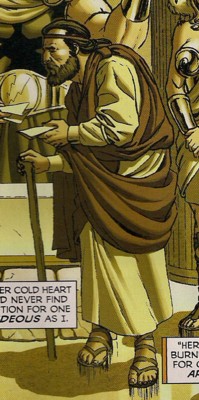
HEPHAESTUS
Real Name: Hephaestus Aetnaeus
Identity/Class: Olympian god
Occupation: God of fire, the forge, smiths and metalworking; weapons-maker of Olympus
Group Membership: Olympian gods, Olympus Group
Affiliations: Automatons, Avengers (Black Knight/Dane Whitman, Captain America/Steve Rogers, Captain Marvel/Monica Rambeau, Doctor Druid/Anthony Ludgate, She-Hulk/Jennifer Walters, Sub-Mariner/Namor McKenzie, Thor Odinson), Eurynome, Hera, Thetis;
formerly Delphyne Gorgon
Enemies: Athena, Amadeus Cho, Gigantes, Delphyne Gorgon, Hercules, Titans, Typhon
Known Relatives: Zeus (father), Hera (mother); Gaea (great-grandmother), Ouranos (great-grandfather, deceased); Cronus, Rhea (grandparents); Demeter, Vesta (aunts); Chiron, Neptune, Pluto (uncles); Venus (former wife, half-sister), Cupid (nephew, former stepson); Ares (brother); Eileithyia, Eris, Hebe (sisters); Apollo, Dionysus, Hercules, Hermes (half-brothers); Artemis, Athena, Persephone (half-sisters); Deimos, Phobos (nephews, deceased)
Aliases: Vulcan
Base of Operations: Olympus; formerly Lemnos, Greece
First Appearance: (Atlas Age; possibly) Venus#12 (February, 1951); Thor I#129 (June, 1966)
Powers/Abilities: Hephaestus possesses the conventional Olympian godly attributes of superhuman physical properties, vitality, and functional immortality. He has not aged since reaching adulthood and is immune to harm from conventional means of injury and cannot get sick from any Earthly disease. Should he indeed incur a non-fatal wound his godly metabolism enables him to recuperate at a superhuman rate of speed. Hephaestus is somewhat stronger than the average Olympian god (Class 30) and can lift about 40 tons optimally. Hephaestus is an inventive genius among the Olympian gods and has manufactured various weapons over the millennia that have been employed by the gods including the breastplate of Zeus called the Aegis and the girdle of Aphrodite called the Cestus. He also designed the metallic female-shaped robots that act as his assistants.
Height: 6'5"
Weight: 645 lbs.
Eyes: Blue
Hair: Black
History: (Incredible Hercules#140 (fb) ) - Hephaestus, son of Hera and Zeus, was born hunchbacked and deformed. Hera despised him so much that she tossed him minutes after his birth from Mount Olympus. After nine days and nine nights Hephaestus landed in the ocean, the impact breaking his leg. The sea-nymph Thetis and and Eurynome saved and raised Hephaestus. She gave him a workshop in her underwater grotto and Hephaestus became a formidable inventor and craftsman. When Hera saw the things he created she realized her mistake and took him back to Olympus.
(Incredible Hercules#127 (fb) ) - Zeus impregnated the Titan Metis, after which the Fates warned that their child would be greater even than him, and so Zeus ate Metis to prevent this. After Zeus developed a massive headache, he had Hephaestus split his head open to relieve the pressure, and Athena emerged fully grown.
(Incredible Hercules#140 (fb) ) - Married to Aphrodite under direction of their mother, Hera, Hephaestus immediately realized she only had eyes for Ares. Hephaestus was himself impressed with Athena, who he felt was wise enough to see past his physical flaws.
(Iron Man: Legacy#1 (fb) ) - At some point Hephaestus forged the Medusa shield and a helmet.
(Incredible Hercules#127 (fb) - BTS / Incredible Hercules#140 (fb)/Iron Man: Legacy#1 (fb) ) - From the hide of a chimera slain by Athena, Hephaestus forged for her his greatest work, the Aegis breastplate. He thought once she saw the gift she would open her heart to him, but when he threw himself at her, she punched him to the ground and departed.
(Incredible Hercules#140 (fb) ) - When Hephaestus caught Venus in bed with Ares one day he caught them in a net and had a mechanical horse parade them around Olympus until Zeus gave Venus back to Hephaestus.
(Incredible Hercules#130 (fb) ) - At some point the Olympian gods defeated the Gigantes with Hercules' help.
(Venus#12/2) - Hephaestus (or Vulcan as he was called by the Romans) was present in the throne room when Venus asked Jupiter for help. (see comments)
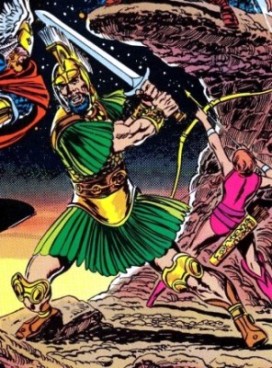
(Thor Annual#5) - Hephaestus was present as Hercules attempted to convince Zeus into starting a war with Asgard. Hephaestus advised Zeus against the battle. Hephaestus was present when Zeus made a pact with the Asgardian skyfather Odin to end a war that had been begun by Hercules against the Asgardians.
(Thor I#129) - Hephaestus was present when Hercules was forced down to Hades, to assume Pluto's place as ruler of the realm.
(Thor I#131) - Hephaestus observed Hercules' return to earth, after he had been rescued by Thor.
(Avengers I#281) - Hephaestus served Zeus in his attempt to gain revenge on the Avengers for injuries Hercules had suffered which Zeus believed the Avengers to be responsible for. Hephaestus fought Thor in Olympus, and during their battle, Thor shattered Hephaestus' boot, tearing at his limp leg. Thor was taken aback by this, as he was suffering from a curse laid on him by Hela which had left him nearly crippled, but Hephaestus did not believe in Thor's empathy. The battle ended when Ares struck Thor from behind, which upset Hephaestus.
(Avengers I#283-284) - Hephaestus brought Thor's hammer Mjolnir to his workshop using a series of winches, in the hopes that he might lift it himself. Just as he seemed to have lifted it, Thor returned to reclaim it with the other Avengers, and Hephaestus set his mechanical woman servants on them. However, Hephaestus was convinced that the Avengers had been wronged by Athena, and allied himself with them in an attempt to end the fighting and help heal Hercules' injuries. Before Hephaestus and the others could explain themselves to Zeus, they were struck down by him for being found with the Avengers. It took Hephaestus some time to recover from Zeus' attack, as his fury against his own children was greater than that he had against the Avengers.
(Hercules III#4 - BTS) - Hephaestus was presumably present with the Olympian pantheon as they convened a board meeting on Earth at the Olympus Group, assuming the appearances of mortal businessmen in an attempt to maintain some connection with humanity. Zeus had gathered them to confront Hera for manipulating Hercules into appearing on a reality television show as part of an attempt to gain revenge upon him, but he wound up being jeered at by his own family for his many infidelities. They finally voted against interfering with Hercules' labors.
(Incredible Hercules#123) - Haphaestus attended a meeting of the Olympus Group called in by Hera. He was shocked when Hera attacked Apollo with a lightning bolt.
(Incredible Hercules#138 (fb) - BTS) - Hephaestus created a variety of machines for Hera. Only he and Hera possessed keys to the elevator that led up to the Continuum chamber.
(Incredible Hercules#139 (fb) ) - Hephaestus created a helmet for Delphyne Gorgon that reactivated her petrifying powers. As payment Delphyne promised to give Athena to Hephaestus as soon as she was turned into stone to finally release all Gorgons from their curse.
(Incredible Hercules#140 - BTS) - Hephaestus sent his golden automatons to retrieve the petrified form of Athena. The automatons escaped with Delphyne's help.
(Incredible Hercules#140) - Far down in the Olympus Group Physical Plant Hephaestus thanked Delphyne and told her his history with Athena. Hephaestus planned to create a gold automaton in Athena's image to create a partner that could never leave him. On their search for Athena, Hercules and Amadeus were attacked by a mechanical dragon and Amadeus hit its weak spot with a stone to destroy it. They then fell into another trap built by Hephaestus. Split up in two cells they were told by Hephaestus that in ten minutes both cells would be filled with deadly gas and that only one of them could survive by pushing a button that opened the others' cell and released the gas in his own cell. When Amadeus and Hercules both pushed the button simultaneously they both escaped, but Hephaestus automatons immediately attacked them. Remembering her oath to protect all women Delphyne (including Athena) told Hephaestus to stand down, but her weapon and the automatons suddenly vanished. Hephaestus maniacally told them that they were too late and that the extinction was nigh.
(Incredible Hercules#141) - After Zeus' death at Typhon's hands Zeus' thunderbolt flew down to Athena's hand, turning her back to human form, and turning her into the Olympians new ruler. Hercules took the key to the elevator from Hephaestus to go after Typhon.
(Incredible Hulks#622) - On Mount Olympus, after Zeus had zapped the Hulk with lightning, Hephaestus informed Hera that the Hulk was still alive. Hera told Hephaestus to let the Hulk get up because she was sure the Hulk understood he had to walk away now. Instead the Hulk attacked Zeus again and Hephaestus ran away to hide because the Hulk had enraged Zeus.
After Zeus defeated the Hulk Hephaestus used unbreakable chains to shackle the Hulk to a rock. He told the weakened Hulk that his strength won't return for a long time after the fight with Zeus and that his wounds would only heal fast enough to keep the vultures fed. Some time after Hephaestus had left the Hulk was freed by Hercules.
Comments: Adapted by Stan Lee and Jack Kirby.
Hephaestus in some versions is said to be born from Hera alone without a father.
According to Homer's Iliad Hephaestus was also married to the goddess called Aglaea.
According to some Greek myths Hephaestus was married to the goddess Charis, one of the Graces, but abandoned her upon marrying the goddess Aphrodite.
Hephaestus (as Vulcan) was seen in the Mercury story in Red Raven Comics#1, but as Mercury was later revealed to be the Eternal Makkari, this was probably an appearance by the Eternal Phastos (or the Eternal Valkin (aka Russian Military General Vulcanin)--Gammatotem
The
image you have posted of him greatly resembles the black-bearded
villain who once mind-controlled a certain golden-armored warrior. A
warrior who might have defeated Thor, himself, if not for Karnilla the
Norn Queen and her Hostess Fruit Pies.
--Carycomic
(Greek-Roman myth) -
Hephaestus is the son of Zeus, king of the immortals of Olympus and his queen,
the goddess Hera. Throughout the time of ancient Greece and Rome, sometime from
2000 B.C. to 500 A.D., Hephaestus was primarily worshipped as the patron god of
all blacksmiths and craftsmen. Unlike the majority of the Olympian gods,
Hephaestus is crippled and uses external means of his own design to enable him
to walk normally. There are two accounts of how Hephaestus became lame; the
first account states that he was born lame and thus was rejected by his mother
Hera because of his deformity. Another account states that Zeus once hurled
Hephaestus from Olympus after siding with Hera in an argument between her and
Zeus. This other version says that Hephaestus fell for nine days and nine nights
before he landed on the island of Lemnos and thereupon built himself a palace
and his forges under a volcano.
Hephaestus took to wife the love-goddess Aphrodite, usually called Venus today, and at some point in their marriage became suspicious that Aphrodite had been committing infidelity. The light-god Apollo was said to have confirmed this to the smith-god and so Hephaestus set about a plan to catch her being unfaithful. Hephaestus fashioned a chain-link net made of Adamantine, the metal of the gods, that was so incredibly strong that no one could escape from it. Eventually, he surprised Aphrodite and the war-god Ares as they lay together in bed. He threw his magic net over them and hauled them before the Olympian gods and displayed them as they were, naked and wrapped in each others arms. To this day, Hephaestus has been estranged from Venus and desires to have little to do with her. Likewise, he openly distrusts his brother Ares since he caught him with his wife.
As the master craftsman of the gods, Hephaestus manufactured various materials, primarily from mystic metal for both the gods and mortal heroes. With help from the Cyclopes, who were his workmen and assistants, he fashioned the Aegis for Zeus. He also made weapons and armor for the other gods and heroes. For Athena, he made her shield and for the god of love, Cupid, he made the arrows. The chariot which the sun-god Apollo rode across the sky was made by Hephaestus and he also fashioned the invincible armor of the demigod Achilles during the Trojan War. Hephaestus is also credited for making the chains which bound the Titan-god Prometheus to Mount Caucasas for centuries before eventually being rescued by the demigod Hercules during the course of his reputed Twelve Labors.
When the worship of the Olympians spread from Greece to Rome years after the destruction of Troy, The Romans adopted Hephaestus as one of their own gods and called him Vulcan.
In Venus#12 a bearded god holding a hammer is seen standing before Mercury. Not to be confused with the Atlas Age Thor (wears blue) & is in this story too.
--Gammatotem
Thanks to Brandon Nash for pointing out Hephaestus was saved by both Thetis and Eurynome according to his handbook profile in OHotMU A-Z HC#14 (and mythology).
Profile by Alex K, Prime Eternal and Will Uchtman. Updates by Markus Raymond.
CLARIFICATIONS:
Hephaestus should not be confused with:
images: (without ads)
Incredible Hercules#140, p6, pan1 (main image)
Avengers I#284, Cover (with Golden Boot)
Appearances:
Venus#12 (February, 1951) - Werner Roth (artist), Stan Lee (editor)
Thor I#129 (June, 1966) - Stan Lee (writer/editor), Jack Kirby (penciler), Vince Colletta (inker)
Thor I#131 (August, 1966) - Stan Lee (writer/editor), Jack Kirby (pencils), Vince Colletta (inks)
Thor Annual#5 (1976) - Steve Englehart (writer), John Buscema
(pencils), Tony DeZuniga and friends (inks), Archie Goodwin (editor)
Avengers I#283-284 (September-October, 1987) - Roger Stern (writer),
John Buscema (pencils), Tom Palmer (inks), Mark Gruenwald (editor)
Hercules III#4 (September, 2005) - Frank Tieri (writer), Mark Texeira (pencils), Jimmy Palmiotti (inks), Axel Alonso (editor)
Incredible Hercules#123 (Janaury, 2009) - Greg Pak & Fred Van Lente
(writers), Clayton Henry & Salva Espin (artist), Mark Paniccia
(editor)
Incredible Hercules#130 (August, 2009) - Greg Pak & Fred Van Lente
(writers), Ryan Stegman & Rodney Buchemi (pencils), Terry Pallot
(inks), Mark Paniccia (editor)
Incredible Hercules#138 (January, 2010) - Greg Pak & Fred Van Lente
(writers), Rodney Buchemi (artist), Mark Paniccia (editor)
Incredible Hercules#139 (February, 2010) - Greg Pak & Fred Van
Lente (writers), Rodney Buchemi & Reilly Brown (artist), Mark
Paniccia (editor)
Incredible Hercules#140-141 (March-April, 2010) - Greg Pak & Fred
Van Lente (writers), Rodney Buchemi (artist), Mark Paniccia (editor)
Iron Man: Legacy#1 (June, 2010) - Fred Van Lente (writer), Steve Kurth
(pencils), Allen Martinez & Victor Olazaba (inks), Ralph Macchio
(editor)
Incredible Hulks#622 (April, 2011) - Greg Pak (writer), Paul Pelletier (pencils), Danny Miki (inks), Mark Paniccia (editor)
First Posted: 05/12/2003
Last updated: 11/17/2020
Any Additions/Corrections? please let me know.
Non-Marvel Copyright info
All other characters mentioned or pictured are ™ and © 1941-2099
Marvel Characters, Inc. All Rights Reserved. If you like this stuff,
you should check out the real thing!
Please visit The Marvel Official Site at: http://www.marvel.com
Special Thanks to www.g-mart.com for hosting the Appendix, Master List, etc.!