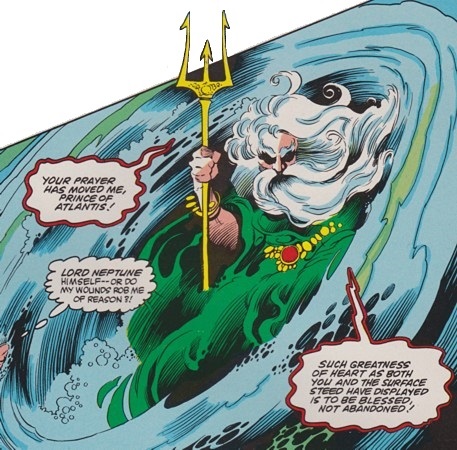
NEPTUNE
Real Name: Poseidon Aegaeus
Identity/Class: Olympian god
Occupation: God of the Seas, patron god of Atlantis and fishermen
Group Membership: Gods of Olympus
Affiliations: Athena, Atlanteans, Ceto, Amadeus Cho, Hercules, Namor the Sub-Mariner, Namora, Ossem, Dick Rogers
Enemies: Amazons (Artume, Hippolyta, others), Andromeda of Ethiopia, Apate, Dolos, Hera, Hulk (Bruce Banner), Hypnos, Davy Jones, Mikaboshi, Nyx, Perseus, Pluto, Set, Suma-Ket, The Titans, Wild One
Known Relatives: Cronus
(father),
Rhea (mother);
Zeus, Pluto
(brothers), Chiron (half-brother);
Demeter, Hera, Vesta
(sisters);
Ouranos (grandfather, deceased), Gaea
(grandmother);
Amphitrite (wife); Nereus (father-in-law), Doris
(mother-in-law);
Cleito
(wife); Evenor
(father-in-law), Leucippe (mother-in-law);
Agenor, Amycus, Arion, Pegasus, Polyphemus, Proteus,
Sinis, Triton, David
Waters (sons); Antaeus,
Belus, Busiris, Chrysaor, Ephialtes, Eumolpus, Orion,
Otus, Pelias, Theseus, (sons, deceased);
Benthiscya, Despoena, Neptunia,
Rhode
(daughters);
Crius, Coeus, Hyperion, Iapetus, Oceanus (uncles);
Mnemosyne, Phoebe, Tethys, Theia, Themis (aunts);
Asteria, Leto, Epimetheus, Prometheus
(cousins), Menoetius (cousin,
deceased);
Venus, Artemis, Athena,
Eiliethya,
Eris, Hebe,
Persephone
(nieces);
Apollo,
Ares,
Dionysus, Hephaestus,
Hercules,
Hermes
(nephew);
Alex Aaron, Cupid, Pan
(great-nephews),
Aeneas
(great-nephew, deceased), Subbie
(nephew, alleged)
Aliases: Earthshaker, Father Neptune, Father of Oceans, Poseidon
Base of Operations: Olympus, mobile within Earth's oceans; formerly Atlantis
First Appearance: Kid Komics#1 (February, 1943)
Powers/Abilities: Neptune possesses the conventional attributes of an Olympian god. Like all Olympians he is immortal: he has not aged since reaching adulthood and cannot die by any conventional means. He is immune to all Earthly diseases and is resistant to conventional injury. If wounded, his godly life force would enable him to recover with superhuman speed. It would take an injury of such magnitude that it dispersed a major portion of his bodily molecules to cause him physical death. Even then, it may be possible for a god of equal power to revive him. Neptune possesses superhuman strength and his Olympian metabolism gives him far greater than human endurance at all physical activities. Neptune is one of the strongest of the Olympian gods, and can lift (press) 70 tons. Among the Olympian gods, his level of strength is matched only by those of Pluto and Ares, and exceeded only by those of Zeus and Hercules.
Neptune's extraordinary energy-wielding abilities are equaled among the Olympians only by those of Pluto and surpassed only by those of Zeus. Only a few of Neptune's many energy-wielding powers have as yet been depicted. Neptune can fire powerful force bolts from his hands, erect powerful, nearly impenetrable force fields, and create inter-dimensional apertures to enable him to transport himself from one dimension to another. He is a shape-shifter able to change his size, shape and form into that of other persons, animals, and objects. He can render himself invisible to mortals but his invisibility does not work on other Olympian gods, and possibly gods from other pantheons. He is also able to heal the injuries of living beings and transform beings into other shapes and forms (such as when he transformed a white stallion into a sea horse).
As the Olympian god of the sea, Neptune is amphibious, able to survive in water and air. He can also communicate with all forms of sea creatures and move at superhuman speeds while swimming.
Weapons: Neptune wields a 6' 5'' enchanted trident made for him by the Cyclopes, one-eyed giants who were trapped in Tartarus along with Neptune by Cronus (see comments). The trident is composed of Adamantine metal that is found in the Olympian dimension and is possessed of mystical properties. The trident allows Neptune to control any body of water. With the trident he is capable of the creation of water elementals, using water to speed ships and water vehicles, creating fog and storms of great intensity, causing tremendous tidal waves, and creating waves of water as transportation that propel him at fantastic speeds. Also, he can cause earthquakes by increasing water pressure.
Height: 6'3"
Weight: 625 lbs.
Eyes: Green
Hair: White
History: (Greek-Roman Myth) - - Neptune was originally called Poseidon and is the second-born son of Cronus, ruler of the race of gods known as the Titans, and his wife, the Titan-goddess of fertility, Rhea. Fearing that he would be dethroned by one of his offspring just as he had overthrown his own father Ouranos, Cronus imprisoned each of his own offspring in Tartarus, the darkest section of Hades, the Olympian underworld, as soon as he or she was born. (Later legends erroneously claimed that Cronus had actually swallowed his children and that they remained alive inside him until Zeus released them). Appalled, the children’s mother Rhea gave birth to Zeus without Cronus’s knowledge and gave him to the primeval Earth goddess Gaea to be raised in secret. The adult Zeus freed his siblings and led them in a successful revolt against Cronus and the Titans.
While it is believed that Neptune was among the offspring of Cronus and Rhea imprisoned in Tartarus until later adulthood, Neptune, like Zeus, had actually escaped this fate when his mother Rhea gave birth to him in Mantineia, Arcadia (in the land known now as Greece). Rhea hid Neptune who was then raised by other gods on the island of Rhodes who taught him how to wield his mystical powers just as the Cyclopes taught Zeus how to wield his own. Approached by the adult Zeus, Neptune helped him free their other siblings and gather allies against Cronus and the other Titans. The war against the Titans lasted for a full decade ending with Zeus and his faction emerging victorious (see Incredible Hercules#123).
After Zeus became ruler of the pocket dimension of Olympus and of the race of Olympian gods, he forged covenants with his elder brothers Neptune and Pluto. Pluto, while still subject to Zeus's edicts, was allowed to become the king of the Olympian underworld without any interference from Zeus concerning the internal affairs of his kingdom. Likewise, Neptune was allowed free reign over the vast oceans and the various water-gods occupying the then ancient Grecian sphere of influence. As a symbol of his station as the prime sea-god Neptune carries an enchanted trident of various properties.
(Mythology) - Neptune sent Ceto to devour Ethiopian princess Andromeda, daughter of King Cepheus, as punishment for her mother Kassiopeia claiming that Andromeda was more beutiful than Neptune's daughters. Chained to Jaffa's rock (seems like Andromeda was taken from Ethopia up to future Isreael to be eaten...quite a journey) as a sacrifice Andromeda awaited Ceto's arrival, but the hero Perseus came to Andromeda's aid and stabbed Ceto to death.
(Hercules: Fall of an Avenger#2 (fb) ) - When Hercules, after his Twelve Labors, joined with Athena and declared war on King Augeas of Elis, Pluto, Neptune, Ares, and other gods went to war with him.
(Avengers: No Road Home#1 (fb) ) - Neptune joined battle against the gigantic two-headed serpent Amphisbaena alongside Athena, Artemis, Hercules, Hermes and Zeus. They vanquished the monster.
Neptune attended the festivities after the battle.
(Silver Surfer Annual#5 - BTS) - At some time, Neptune imprisoned the Elder God the Wild One deep within the Pacific Ocean.
(Spectacular Spider-Man Annual#9/5 (fb) - BTS) - At some point prior to 5900 BC, Neptune came to be worshipped by some of the Homo mermani.
(Namor I#36-38 (fb) - BTS) - Suma-Ket took over Atlantis, leading its people to the worship of his dark gods, ritual sacrifice, and to the slaughter of the Priests of Neptune.
(Namor I#38 (fb) - BTS) - Kalen, grandson of Kamuu, rallied his people to rise up against Suma-Ket and his Unforgiven Dead.
(Namor I#37 (fb) - BTS / Namor I#38 (fb) - BTS) - Suma-Ket's host was defeated by the rebellious lords of Atlantis (with the aid of Neptune himself) in a bloody battle that turned the oceans indigo with blood, but the Unforgiven Dead were strong and could not be destroyed.
(Namor I#36 (fb) - BTS) - The lords of Atlantis banished Ket and his court beyond the Earthly plane to the Grey Waters, a mystical prison that was not quite death, but was certainly not life.
(Spectacular Spider-Man Annual#9/5) <2000 years ago> - Neptune encountered a cult of Atlanteans who worshipped the Elder God Set, and destroyed them. He then came to dwell in the undersea city of Atlantis, and became their patron deity.
(Sub-Mariner#17 (fb)) - Neptune led Atlantis into battle, armed with his sacred trident, which he had forged in the brazier of living flame (see comments), on the original site of Atlantis. When he left Atlantis, he ordained that the trident be dipped anew in that same flame when his high priests should decree.
(Greek-Roman Myth) - Neptune took as his wife the goddess Amphitrite, a daughter of the elder water deities Nereus and Doris. He and Amphitrite had two daughters Rhode and Benthiscya and a son Triton whose godly power enabled him to assume the form of a merman. However, Neptune was similar to his younger brother Zeus in that he had several affairs with both mortal Earth women and Olympian goddesses and thus fathered numerous offspring. Like Zeus, his children were sometimes born as mortals or immortals.
(Incredible Hercules#128 (fb)/Greek-Roman Myth) - Neptune seduced Medusa Gorgon, a Chase Priestess of Athena.
(Greek-Roman Myth) - By his union with the Gorgon Medusa he fathered the warrior Chrysaor and the magical flying horse, Pegasus. Akin to Zeus who transformed himself into Amphitryon of Troezen to mate with his wife Alcmena who became the mother of the demigod Hercules, Neptune once disguised himself as the husband of the mortal woman Aethra and fathered the Athenian hero Theseus. Other various offspring of Neptune's include: Eumolpus, the Giant Sinis, the Cyclopes Polyphemus, Orion, King Amycus, the shape-shifting god Proteus, Agenor, Belus, Pelias, and Busiris who once became the King of Egypt. Poseidon also had two twin giant sons, Otus and Ephialtes, who once attempted to storm Olympus and overthrow Zeus and the Olympians before meeting their deaths at each other's own hands in a hunting accident.
One of the most infamous affairs of Neptune involves his sister, Demeter, Olympian goddess of the harvest. Neptune pursued Demeter who, although first resisted his advances, eventually submitted to him. The pair united, Demeter in the form of a mare and Neptune in the form of a horse, and became the parents of Arion, the god of horses and Despoena, the goddess of fruit.
Neptune, in past eras, was known to quarrel with his fellow Olympians to act as the patron of particular Greek cities. For example, the sea-god was once involved in a competition between himself and his niece, the goddess of war Athena, for the city of Athens. To convince the people to name the city after him and make him their patron god, Neptune used his magical trident to produce a flowing spring. However, Athena won as a result of giving the Athenians the far more useful olive tree (the flowing spring was salt water, I believe). Neptune could also be a very moody sea-god and at times used his powers to create earthquakes, floods and storms to inflict fear and/or punishment on people as revenge. Though difficult at times, Neptune could be cooperative as it was he who aided the Greeks during the Trojan War before Zeus forbade the Olympians from participating in it. After the Trojan War ended, Neptune became angered against the hero Odysseus also known as Ulysses, when he blinded the sea-god's son, the Cyclopes Polyphemus. In his rage against this act Neptune saw to it that Odysseus's journey back to Ithaca was full of trials and difficulties. Indeed it took Odysseus 10 years to reach Ithaca after he and his men had departed from Troy.
When Neptune's great-nephew Aeneas, who was the son of his niece, the love-goddess Aphrodite, left war-ravaged Troy and eventually became the ancestor of the Roman peoples, Neptune was worshipped as the prime sea-god by the ancient Romans as he was also by the ancient Greeks who revered him under his original name of Poseidon.
(Journey
Into Mystery I#31/1) - Circa the 18th Century, Neptune's son Captain
David Waters enjoyed his father's protection sailing across the ocean
in return for tributes. When Waters' crew deserted him in fear, Neptune
rose from the sea and pulled Waters and the ship underwater.
(Avengers: No Road Home#4 (fb) ) - Neptune joined the Olympians' battle against Nyx and her children Hypnos, Apate and Dolos when they turned on the other Olympians. When the battle was over, Neptune had Nyx on the ground at the tip of his trident. Zeus afterward exiled Nyx and her children into a prison of eternal darkness.
(Kid Komics#1) - In the mid-20th Century, the amphibious Subbie the Sea-Going Lad considerd "Father Neptune" both his uncle and his godfather. When Subbie reached an age where he felt the need to go exploring beyond his undersea home, Father Neptune gave the youth his blessing, and gifted him with a sailor suit and a P-T Boat.
(Venus#12/2) - Neptune was once summoned by Venus to assist her against a race of underwater-dwelling creatures who had encountered the ship Honolulu Queen. After learning that the creatures had been forced to the surface by atomic tests, Neptune promised to help them.
(Venus#18/4 BTS)
- Neptunia, a daughter of Neptune, believed that he had been killed by
atomic tests performed by humans, and assaulted the surface until she
was stopped
by Venus.
(Spellbound#28/4) - Davy Jones' multiple attempts to
sink a small cargo schooner called Nancy captained by Dick
Rogers were foiled by "the Old Man of the Sea", King Neptune.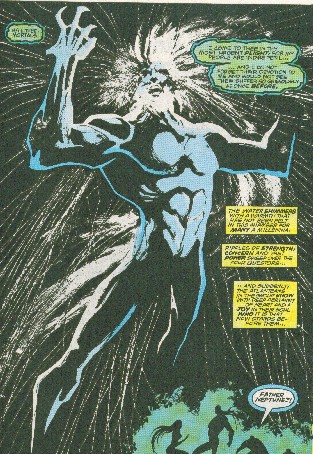
(Thor: Blood Oath#3-4) - Neptune observed Hercules and Thor as they fought over the enchanted pig of Dionysus, and held a wager with Zeus over the outcome.
(Tales to Astonish I#70 - BTS, 71, 72-73 - BTS, 75) - In order to reclaim the throne of Atlantis, Namor began a quest for Neptune's trident, which had been left in Atlantis as a reminder of Neptune's power. Neptune watched over Namor during this quest, and appeared to him in order to encourage him, often speaking through ocean life. Namor finally proved himself worthy of the trident, and Neptune allowed him to return it to Atlantis.
(Sub-Mariner#68) - Atlantis was seemingly destroyed when all of its people collapsed from the exposure to a sunken canister of US nerve gas, released during a battle between Namor and Virago. In despair, Namor traveled to the Grotto of the Ancients, where he prayed before the altar of Neptune. His god appeared to him, telling him that it was all just part of a prophecy, in which Atlantis would arise, at the forefront of all nations. Neptune named Namor as the agent of that prophecy, and marked his belt with a symbol of his faith: his trident.
(Marvel Fanfare I#16/2) - An injured Namor called on Neptune to save a valiant white stallion from drowning in the middle of the ocean after its ship sunk. Neptune responded by transforming it into a giant white seahorse.
(Avengers I#282) - Neptune was sent by Zeus to the underwater kingdom of Deluvia, ruled by Namor, and took Namor captive, turning him over to Cerberus. Neptune hated to perform the deed, but still assisted his brother in his vendetta against the Avengers.
(Avengers I#285) - Ultimately, Zeus decreed that all Olympians would be forbidden to return to earth, including Neptune. Neptune was incensed at the thought of abandoning his Atlantean worshippers, but Zeus forced him to obey.
(Namor Annual#2) - While Namor was temporarily residing within the body of the human Rick Jones, Neptune appeared to him, and bestowed some of his power upon him so that Namor would possess a degree of superhuman abilities despite his mortal body.
(Namor I#37) - After Namor was slain by the sorcerer Suma-Ket, Neptune appeared and restored him to life, then bestowed upon him a suit of sacred Atlantean armor with which to battle Suma-Ket.
(Man-Thing III#7 (fb)) - While deep in prayer and meditation, Namor had a vision of Neptune, who told him that the fate of Atlantis--of all worlds across infinity--depended on Namor's making a pilgrimage to the Nexus of Realities in Citusville, Florida, and seeking the counsel of the Man-Thing.
(Hercules III#4 - BTS) - Neptune was presumably present with the Olympian pantheon as they convened a board meeting on Earth at the Olympus Group, assuming the appearances of mortal businessmen in an attempt to maintain some connection with humanity. Zeus had gathered them to confront Hera for manipulating Hercules into appearing on a reality television show as part of an attempt to gain revenge upon him, but he wound up being jeered at by his own family for his many infidelities. They finally voted against interfering with Hercules' labors.
(Ares#1 (fb)) - After a battle with Pluto, Neptune met with the other gods of Olympus as they discussed how distasteful Ares' brutality was to them.
(Ares#3-5) - Neptune fought alongside the gods of Olympus against the Japanese demons led by Mikaboshi as they launched an attack on Mikaboshi's fortress. They were aided by benevolent eastern gods, and one of them provided Neptune with water that he used to flood Mikaboshi's army. The gods were ultimately victorious over Mikaboshi.
(Incredible Hercules#123 (fb) ) - Neptune was attacked by Hippolyta during meditation in Melanesia. She and her warriors easily defeated Neptune, who had been weakened since he had to stay on Earth after Olympus' destruction. The Amazons brought Neptune to their stolen Atlantean base and Hippolyta forced him sign over his shares in the Olympus Group to Hera and Pluto.
Eventually Artume, Hippolyta's daughter, approached him and offered him her help if he shared the secrets of the ancient artifacts on a base she showed him. Neptune was willing to believe her and told her of the Tablet of Zhered-Na and the Omphalos.
(Incredible Hercules#122) - When Harcules, Namor and Namora stormed the Amazons base one of Artume's soldiers threatened to shoot Neptune in the head if Namor, Namora and Hercules came any closer.
(Incredible Hercules#123) - Namora knocked out the soldier with a kick and then broke Poseidon's chains to free him.
After he told his liberators about what he had revealed to the Amazons Poseidon went with Namor, who escorted him to the sacred grottos where Atlantean priests were going to heal his wounds.
(Hercules: Fall of an Avenger#1) - Athena led the Olympus Group including Poseidon to the funeral of Hercules.
(Hercules: Fall of an Avenger#1) - Poseidon sided with Athena when some of the other gods challenged her after she declared herself queen of the Olympians and Amadeus the leader of the Olympus Group. Poseidon chose Namor as his representative, but the battle between the mortal proxies ended in a draw when they decided to stop fighting and instead went up against the gods. After the fight everyone went their own way.
(Incredible Hulks#621) - On his way up Mount Olympus to ask Zeus for help the Hulk was attacked by several gods. Neptune tossed him with a wave against the side of Mount Olympus, but the Hulk was only annoyed that Neptune called him a hero and kept going.
Comments: Adapted by Jim Mooney.
I don't remember the exact details of Namor's quest with the Man-Thing
(who
had gained intelligence by merging with K' admon, the first
man (ie. Adam K'admon)), but they went to the City of the Golden
Gate--another
fragment of pre-Cataclysmic Atlantis that had been thought lost in the
Great
Cataclysm. There they encountered Evenor, an ancient king of Atlantis
who
had achieved godhood as the Lord of Water Spirits. A fragment of the
Nexus
of Reality had been somehow dislodged from its normal location and
integrated
into the sacred Shroud of Cleito (the wife of Neptune and the daughter
of
Evenor). Namor was torn between returning the Nexus and saving the
universe,
versus preserving the sanctity of the sacred Shroud.
Somehow everything worked out just fine...
Some sources (including the original Official Handbook of the Marvel Universe) have referenced Neptune as having created the Homo mermani, from a group of drowning sailors. Other sources consider the Homo mermani to be the result of Deviant or Inhuman manipulation, who just came to worship Neptune. The world may never know, but for some reason, I favor the former theory (being created by Neptune). Take a big, fat guess which one Prime Eternal prefers (and which part of it)!!!
The divergent origins of Neptune's tridents can possibly be reconciled
or
resolved. Neptune could have made the trident with the Cyclopes or been
somehow involved in it, and brought it to Atlantis from Tartarus or
Olympus
through a dimensional portal. Or, it could be that the flashback from
Sub-Mariner
I#17 is just a big fat lie. It was told by Kormok, who used it to send
Namor
on a doomed quest, or more specifically, a trap involving the Alpha
Centaurians
and Dynorr the Stalker. However, Vashti backed Kormok's telling of the
legend
up, and Vashti's no dummy!
--Snood.
Possibly Neptunia was unaware that her father Neptune was truly immortal, and did not realize that he had survived the atomic tests.
Neptune's son Triton is not the same being as Triton of the Royal Family of Inhumans.
The
sea-goddess Neptunia, Neptune's daughter
in the Marvel Universe, has no actual analogue in Greek mythology.
In a message board discussion with new INVADERS
writer Alan Jacobsen, the subject of "Subbie" came up, a purported
nephew
of Neptune. Now Subbie was purportedly the nephew of Neptune, but
I'd
lay odds that should Subbie ever be revived, he would prove not to be
"Neptune's
nephew", but more likely perhaps a clone of Namor, just as Namorita is
now
said to be a clone of Namora. I personally doubt he's canonical to add
to
Neptune's relatives, but he merits a mention in the comments.
--Loki
In the Amalgam universe seen in Amazon#1, Neptune confronted Amazon (Ororo Munroe) over mortals forgining (?) their ancient pagan rites. She pointed out the error in his ways by remarking on how modern civilization had been based on ideals and aspects created by the Olympians and the heritage they left behind.
Another alternate Earth Neptune was observed in What If I#41.
Profile by Alex K, Will U, Prime Eternal, Snood and Markus Raymond.
CLARIFICATIONS:
Neptune should not be confused with:
images: (without ads)
Marvel Fanfare I#16, p28, pan2 (main image)
Appearances:
Venus#3 (December, 1948)
Venus#12 (February, 1951)
Venus#18 (February, 1952)
Journey Into Mystery I#31/1 (February, 1956) - uncredited writer, Bill
Benulis (pencils & inks), Stan Lee (editor)
Spellbound#28/4 (June, 1956)
Tales to Astonish I#70-73 (August-November, 1965) - Stan Lee
(writer/editor), Gene Colan (pencils), Vince Colletta (inks)
Tales to Astonish I#75 (January, 1966) - Stan Lee (writer/editor), Gene
Colan (pencils), Vince Colletta (inks)
Sub-Mariner#17 (September, 1969) - Roy Thomas (writer), Marie Severin
& Jack Katz (pencils), Mike Esposito (inks), Stan Lee (editor)
Sub-Mariner#68 (January, 1974) - Steve Gerber (writer), Don Heck
(pencils), Jim Mooney (inks), Roy Thomas (editor)
Marvel Fanfare I#16 (September, 1984) - Bill Mantlo (writer), Mike
Mignola (artist), Al Milgrom (editor)
Avengers I#282 (August, 1987) - Roger Stern (writer), John Buscema
(pencils), Tom Palmer (inks), Mark Gruenwald (editor)
Avengers I#285 (November, 1987) - Roger Stern (writer), John Buscema
(pencils), Tom Palmer (inks), Mark Gruenwald (editor)
Spectacular Spider-Man Annual#9 (1989) - Peter Sanderson (writer), Mark
Bagley (pencils), Bob Lewis (inks), Mark Gruenwald (editor)
Namor Annual#2 (1992) - Ron Marz (writer), James Fry (pencils),
Christopher Ivy (inks), Terry Kavanagh (editor)
Namor I#36-37 (March-April, 1993) - Bob Harras (writer), Jae Lee
(artist), Terry Kavanagh (editor)
Namor I#38 (May, 1993) - Bob Harras (writer), Jae Lee (pencils), Bill
Sienkiewicz, Shawn McManus, Chris Ivy, Malcolm Jones & Jimmy
Palmiotti (inks), Terry Kavanagh (editor)
Silver Surfer Annual#5 (1992) - Ron Marz (writer), Tom Morgan (artist),
Craig Anderson (editor)
Man-Thing III#7 (June, 1998) - J.M. DeMatteis (writer), Liam Roger
Sharp (artist), Mark Bernardo (editor)
Hercules III#4 (September, 2005) - Frank Tieri (writer), Mark Texeira
(pencils), Jimmy Palmiotti (inks), Axel Alonso (editor)
Thor: Blood Oath#3-4 (December, 2005-January, 2006) - Michael Avon
Oeming (writer), Scott Kolins (artist), Tom Brevoort (editor)
Ares#1, 5 (March, July, 2006) - Michael Avon Oeming (writer), Travel
Foreman (penciler), Derek Fridolfs (inker), Warren Simons (editor)
Incredible Hercules#122-123 (December, 2008 - January, 2009) - Greg Pak
& Fred Van Lente (writers), Clayton Henry & Salva Espin
(artists), Mark Paniccia (editor)
Incredible Hercules#128 (June, 2009) - Greg Pak & Fred Van Lente
(writers), Dietrich Smith (pencils), Terry Pallot (inks), Mark Paniccia
(editor)
Hercules: Fall of an Avenger#1-2 (May-June, 2010) - Greg Pak & Fred
Van Lente (writers), Ariel Olivetti (artist), Mark Paniccia (editor)
Incredible Hulks#621 (March, 2011) - Greg Pak (writer), Paul Pelletier
(pencils), Danny Miki & Crimelab Studious (inks), Mark Paniccia
(editor)
Avengers: No Road Home#1 (April, 2019) - Mark Waid, Al Ewing & Jim
Zub (writers), Paco Medina (pencils), Juan Vlasco (inks), Tom Brevoort
(editor)
Avengers: No Road Home#4 (May, 2019) - Mark Waid, Al Ewing & Jim
Zub (writers), Sean Izaakse (artist), Tom Brevoort (editor)
First Posted:
07/30/2003
Last updated: 09/28/2016
Any Additions/Corrections? please let me know.
Non-Marvel
Copyright
info
All other characters mentioned or pictured are ™ and © 1941-2099
Marvel Characters, Inc. All Rights Reserved. If you like this stuff,
you
should check out the real thing!
Please visit The Marvel Official Site at: http://www.marvel.com
Special Thanks to www.g-mart.com for hosting the Appendix, Master List, etc.!