 CAPTAIN AMERICA
of the Revolutionary War
CAPTAIN AMERICA
of the Revolutionary War
Real Name: Steven Rogers
Identity/Class: Revolutionary
War era human;
citizen of the United States of America;
former citizen of an unidentified British Colony
Occupation: Soldier (rank of captain); freedom
fighter;
former blacksmith
Group Membership: Continental
Army
Affiliations: Ulysses
Bloodstone, Colonel Miller, Sam, Elizabeth
Shaw-Worthington, Major-General
Wallace Worthington;
formerly James Green;
Enemies: British Army,
James Green, "Sir" William Taurey, Andrew (William's nephew; aka Captain
Yankee Doodle);
indirectly the Hellfire Club's
American branch's Inner Circle (Sir
Patrick
Clemens, Commander
George Clinton, Lady
(Jean) Grey, Lady Diana
(Knight));
possibly some incarnation of the Red
Skull as a "Hessianazi"
Known Relatives: Steve Rogers (Captain America,
descendant; see comments)
Aliases: None
Base of Operations: Unrevealed;
formerly mobile throughout Colonial America;
First Appearance: (Steven Rogers) Captain
America I#194 (February, 1976);
(costumed; unidentified) Marvel
Treasury Special featuring Captain America's Bicentennial Battles (June,
1976);
(Rogers confirmed to be in costume) Captain
America: Sentinel of Liberty#6/3 (February,
1999);
(identified as Captain America) X-Men: Hellfire Club#2 (February, 2000)
|
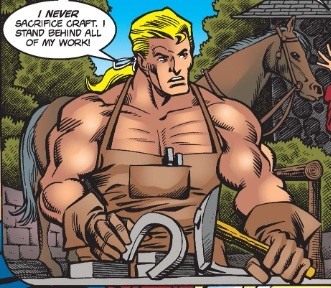
. Powers/Abilities: Steven Rogers was an
excellent blacksmith, marksman, equestrian and unarmed
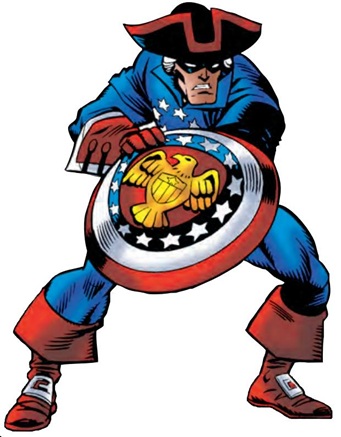
combatant, and he was proficient using his steel shield as both
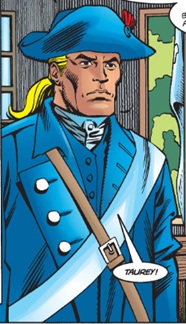
a defensive and offensive weapon. He was highly athletic, noble, patriotic and willing to risk his own life for others. . Weight: 220 pounds Eyes: Blue Hair: Blond (often wore a white wig as Captain America) |
| . . History: (Captain America: Sentinel
of Liberty#6/3 (fb)) <Around July 4, 1776> - After Rogers replaced the shoe a British soldier's
horse had thrown, the redcoat criticized his speed, noting he
expected a job done well rather than in haste. Rogers assured
the soldier that he never sacrificed his craft and stood behind
his work, but when he asked about his fee, the redcoat told him
his payment was the honor of providing service to a soldier of
his majesty, King George. Rogers replied that that was no honor
to him and demanded his due, but the soldier rode off, laughing.
Immediately afterward, a carriage carrying William Taurey, a British loyalist who fancied himself an aristocrat and required his servants to call him "Sir William," approached, and its driver ordered Rogers out of the way to clear the road for "Sir William." Rogers told Taurey of the soldiers actions, but Taurey dismissed and rode on while commenting, "Ignorant churl...he should be honored to serve his betters." Soon after, at "The Abbey
Tavern," Rogers discussed the matter with his friend Sam, who
warned him against crossing Taurey. Rogers argued that they were
free men and should not live in fear of offending the king or
his high-handed men. As Sam and others aruged about the growing
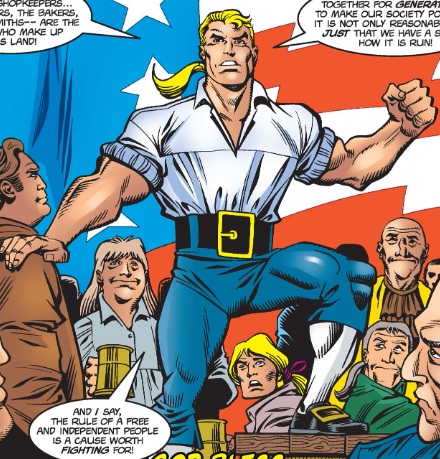
presence of the British troops, Steven's friend James Green
announced that Congress had issued the Declaration of
Independence and that they were no longer colonies but
independent states. Rogers was ecstatic, noting that they truly
had something to fight for. Ulysses Bloodstone, present at
the tavern, wished them luck and, before heading out, noted how
many lands had aspired to democracy but that ultimately power
was held by the elite few and that the common men had ever been
pawns. Rogers assured Bloodstone that he was one common man who
would no longer be a pawn. |
.
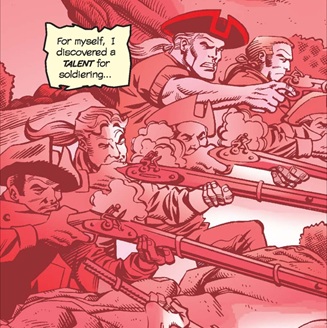
. That day, Rogers closed his blacksmith shop and enlisted with his fellow countrymen in the Continental Army. Despite their lack of experience with combat, they practiced until they could give the British pause. |
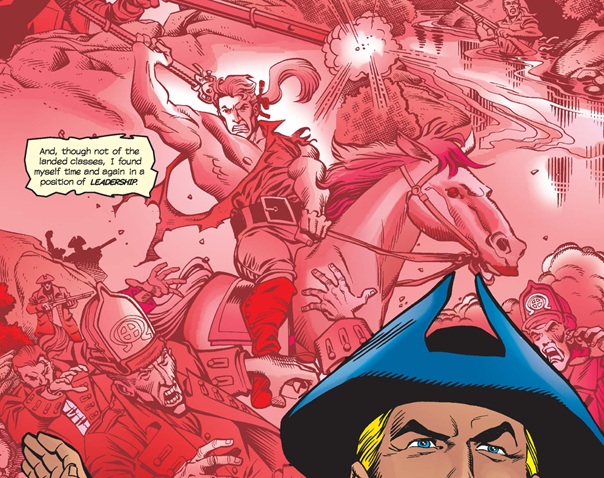 . .
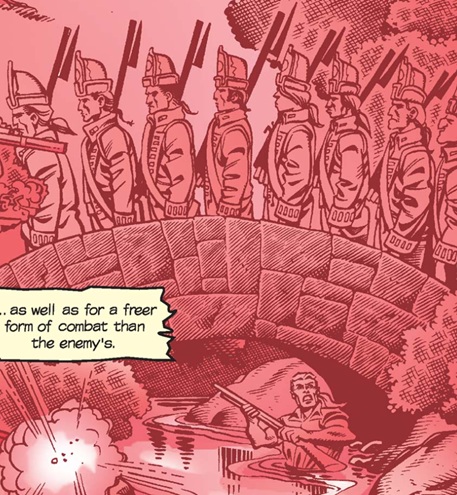
Discovering a talent for
soldiering, particularly with a freer form of combat than the
enemy's (notably engaging in guerilla warfare), Rogers found
himself time and time again in a position of leadership despite
not being of the landed classes. Rogers and his fellows took part in a score of battles from Trenton, New Jersey to Guilford Courthouse, near Greensboro, North Carolina, receiving many promotions along the way. . |
|
(Captain America: Sentinel
of Liberty#6/3 (fb)) <A week before the main story> -
Rogers, now a captain, was given a special assignment to find
out who was, working with William Taurey, passing information on
the Continental Army's troops movements to the British. (Captain America: Sentinel
of Liberty#6/3 (fb)) <August 16,
1981> - Per orders, Rogers posed as a servant at one of
Taurey's parties, where he silently seethed in righteous
indignation as Taurey had his nephew Andrew act as the costumed
"Captain Yankee Doodle" in a mockery of the the Continental
Army, wearing a costume based on the Colonial Flag. He was
further upset to see his old friend James secretly allied with
Taurey. Taking out Andrew in the courtyard, Rogers donned his costume and listened in a private meeting in which James revealed Washington's movements to Taurey and his associates. Thought to be Andrew, Rogers called to his uncle, and when he was dismissed as this was none of his concern, Rogers countered that he felt that it was... (Captain America: Sentinel
of Liberty#7 (fb)) - The costumed Rogers assaulted the
conspirators, kicking down Taurey and noting that while he had
his nephew wear this cosutme as a mockery of the United States
of America and suggested it was not so funny now. He then
confronted and punched out James Green, noting how he disgraced
his former self who spoke about independence. Recognizing
Rogers, James told him that he never thought that the war would
run so long or be so costly, and that "Sir" William paid so
well. Rogers' disgust was interrupted
by an associate of Taurey's who drew a dagger and approached
him, but Taurey's estate's servants, disgusted by Taurey's
abusive treatment and inspired by Rogers, held back the
loyalists at swordpoint. With Taurey himself having fled, Rogers
asked the former servants to turn Green over to Colonel Miller
at Carter's Crossing, which they were more than happy to
perform. (Captain America I#194 (fb) - BTS / Captain America: Sentinel of Liberty#7 (fb)) - Rogers then took after Taurey, hoping to stop him
before he could reach the redcoats. (Captain America: Sentinel
of Liberty#7 (fb)) - Hearing of Rogers
actions and learning of his trail from Taurey's servants, Major
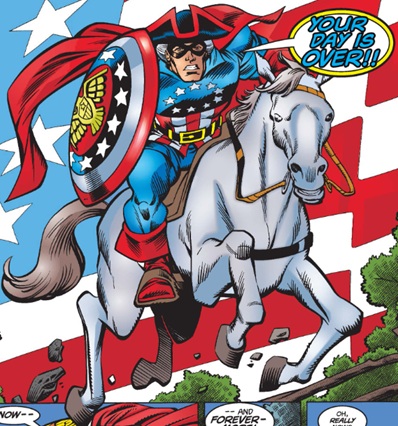
Bloodstone insisted his troops come to Rogers' aid. (Captain America I#194 (fb) - BTS / Captain America: Sentinel of Liberty#7 (fb)) - Catching up to Taurey, Rogers
grabbed him and denounced that his day was over now and
forevermore. However, a group British soldiers with whom Taurey
was meeting held Rogers at gunpoint, forcing his surrender. They
initially assumed him to be a fancily-dressed highwayman, and
when Taurey revealed her was a rebel spy, they prepared to hang
him. (Captain America: Sentinel
of Liberty#7 (fb) - BTS) - Taurey instead
convinced them to facilitate a duel in which Rogers was --
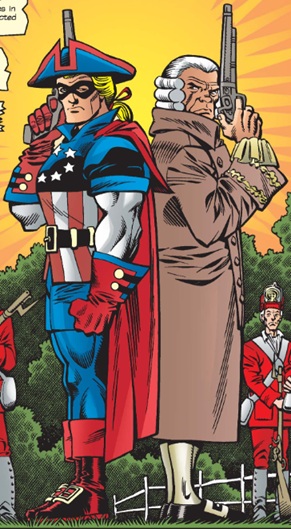
unbeknownst to him -- given an empty pistol. (Captain America I#194 (fb) - BTS / Captain America: Sentinel of Liberty#6/3) - The still-costumed Rogers stood back-to-back with Taurey in preparation for the duel.
Alerted by Bloodstone, Rogers spun around quickly, and Taurey's bullet ricocheted off his shield and killed Taurey instead. (Captain America: Sentinel of Liberty#7 (fb)) - Pleasantly surprised by Bloodstone's change of heart and grateful for his assistance, Rogers considered how while Taurey had intended the costume to be an object of ridicule, he (Rogers) saw in the costume strength, valor and justice: "I see the unity of our quest." (Captain America: Sentinel of Liberty#7 (fb) - BTS) - Rogers detailed his adventures into a diary that was kept by his family. |
 (X-Men:
Hellfire Club#2 (fb)) - Major-General
Wallace Worthington allegedly fought alongside Captain America,
although he did not realize that Captain America was his friend,
Steven Rogers. (X-Men:
Hellfire Club#2 (fb)) - Major-General
Wallace Worthington allegedly fought alongside Captain America,
although he did not realize that Captain America was his friend,
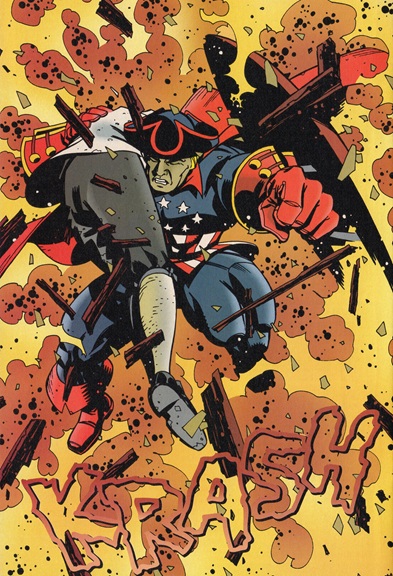
Steven Rogers. (X-Men: Hellfire Club#2 (fb)) - Rogers attended a party at the Hellfire Club Mansion in Philadelphia alongside his friend, Major-General Wallace Worthington, who had recently been appointed to succeed the traitorous former commandant of Philadelphia, Benedict Arnold. (X-Men: Hellfire Club#2 (fb) - BTS) - The Hellfire Club's Inner Circle -- notably Sir Patrick Clemens, Commander George Clinton, Lady Diana (Knight) and Lady (Jean) Grey -- sought to manipulate Worthington to foil the Continental Army's revolution against the British government. To this end, Lady Grey's protege', Elizabeth Shaw, was sent to romance him. (X-Men: Hellfire Club#2 (fb)) - Wallace bragged to Elizabeth that he had fought alongside Captain America and considered him quite the soldier. He asked Rogers if he agreed, and he confirmed that he did, coyly adding, "Whoever he is under that mask." After Elizabeth accepted Wallace's offer to dance, Wallace teased Steven, "Better luck next time" (see comments). Rogers apparently attended Wallace and Elizabeth's wedding, which had occurred after a whirlwind courtship. (X-Men: Hellfire Club#2 (fb)) - Captain America fought alongside Worthington and Ulysses Bloodstone fought British soldiers. (X-Men: Hellfire Club#2 (fb) - BTS) <December, 1981> - Although Elizabeth had fallen in love with Wallace, Lady Grey reminded her that she was to seduce Worthington into parting with military secrets and threatened to "cut her strings." Accompanied by two men, Lady Grey confronted Worthington at his house that evening, after he had had a few drinks, and they apparently shot him, after which they set the house on fire. (X-Men: Hellfire Club#2 (fb)) - Having planned to meet Wallace that night, Rogers approached on horseback, considering that Wallace was likely already drunk, as he was a fine soldier in the thick of things, but that he... His thoughts were disrupted by a fleeing coach car (likely containing Grey and her allies) that rushed past him as the driver told him to get out of the way. Before he could react to that, Rogers saw that Worthington's home was on fire. Changing into his Captain America costume, Rogers used his shield to smash into the building. As a distraught Elizabeth approached, Rogers smashed back out of the building with Wallace on his shoulder. After Rogers landed and laid Wallace down, Wallace told Elizabeth that they had wanted secrets but that he had told him nothing. And then Wallace apparently died. |
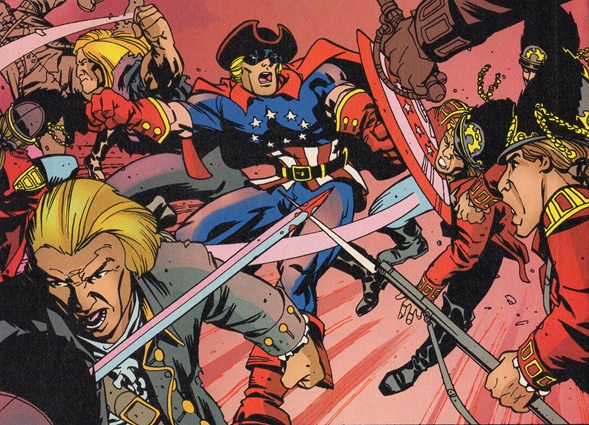
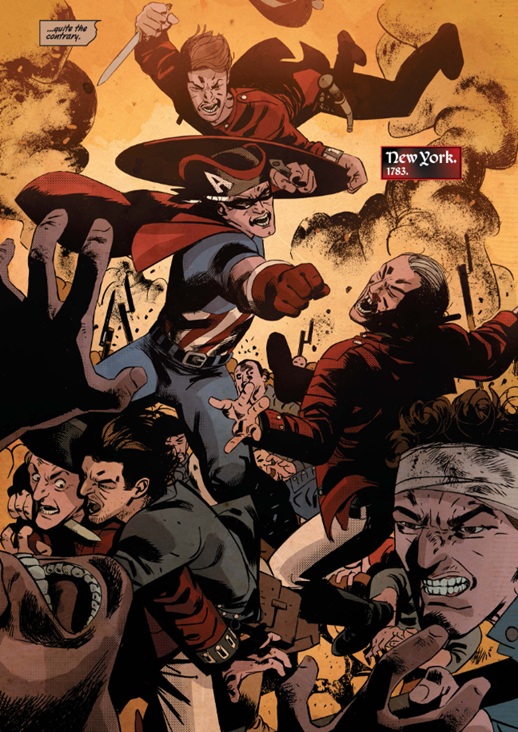 . .. (Ruins of Ravencroft: Sabretooth#1) <1783> - In New York, Captain America and other Continental soldiers fought British soldiers and possibly others, who were apparently affected by the madness associated with Ravencroft and/or the Cult of Knull. 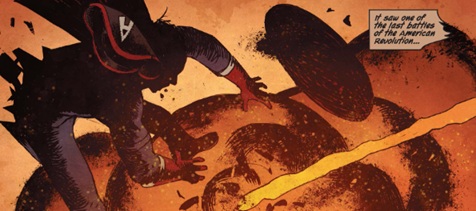 Caught in an explosion, Captain America
apparently fought his last battle there.
Caught in an explosion, Captain America
apparently fought his last battle there. . . . . . . . . . . . . . . . . . . . . 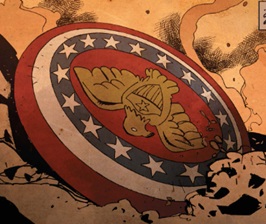 |
 (Captain America: Sentinel of
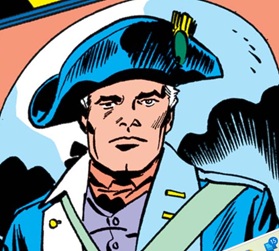
Liberty#7 (fb) - BTS) - There was a portrait painted of Steven
Rogers around the end of the Revolutionary War. (Captain America: Sentinel of
Liberty#7 (fb) - BTS) - There was a portrait painted of Steven
Rogers around the end of the Revolutionary War.(Captain America: Sentinel of Liberty#7 (fb) - BTS) - The Rogers family lost track of the portrait over a generation before the time of World War II. (Captain America: Sentinel of Liberty#7 (fb) - BTS) - Rogers served as the namesake for the 1922 born Steven Rogers. (Captain America: Sentinel of Liberty#7 (fb) - BTS) <January, 1941> - Having been enhanced by Professor Erskine's Super-Soldier serum, the artistic Steve Rogers sketched drawings of what he imagined his namesake's costumed form to look like. He shared these drawings and the diary with his superior officer General Chester Phillips, asking him to pass the diary along to the Smithsonian if anything ever happened to him. Inspired by Rogers' drawings and seeking an American symbol and hero to oppose the Nazi Red Skull, Phillips had a modernized costume designed for Rogers as Captain America. (Captain America I#194 - BTS) - In the modern Heroic Age, Sir Taurey's descendant William Taurey, who led the Royalist Forces of America, sought to locate Captain Rogers' descendant and gain vengeance on his own ancestor's behalf. (Captain America I#194 - BTS) - The modern day Captain America had a dream about his ancestor who had fought in the Revolutionary War. When he shared this with his partner, the Falcon (Sam Wilson), Sam denounced him as probably being a slave owner. Cap argued that he had read his ancestor's diary and that there was no mention of owning slaves, but Sam was unconvinced (see comments). |
How does Captain America (Steven Rogers) of the Revolutionary War's status as an ancestor of Steve Rogers fit with established continuity?
Courtesy of Loki:
Captain
America (2013) #1 does make it sound like both of Steve's parents are
immigrants - p2, pan1, Sarah talking to Joseph: "Since
we got to this country it's all been on me."
Though it's feasible from that dialogue that Cap's dad might be
American and have met Sarah when he was in Europe, perhaps as a First
World War soldier? If he met and romanced her then, that dialogue might
still work, and permit Joseph to be American.
We also meet
Steve's grandfather Ian (regarding whom, young Steve said to his ailing
mother that "granpa passed away last winter"); Ian seems to be Sarah's
father, given she calls him Papa, but I'm not sure that's definite;
though it's not as common now, it wasn't that unusual in the past for
married people to refer to their partner's parents by parental titles
rather than given names.
Mythos: Captain America says Joseph served in the 1st Battalion, 26th Infantry and took a bullet during the push for Soissons, France, which doesn't prove he was born in the States but would fit my theory that he could have met Sarah during that overseas service and so she might be the only one who is an immigrant.
Adventures of
Captain America#1, p11, pan7 - Lt Col James Fletcher states "Parents:
Joseph and Sarah Rogers. BOTH Irish immigrants."
Back to me (Snood):
The story involving Steven Rogers in
X-Men: Hellfire Club#2 is supposed to take place six months
after Elizabeth Shaw was taken in by Lady Grey, which took place in
1780. That date doesn't quite work because even if it were December
31st, 1780, Rogers did not first don the costume and start acting as
Captain America until August 16, 1981, which is over 8 months later.
Even though Rogers is not shown as Captain America until after the
"whirlwind courtship" of Wallace Worthington and Elizabeth Shaw, Captain
America was referenced at the party, and Rogers feigned ignorance of
Captain America's true identity.
That story was told by Wallace Worthington's
descendant Warren well over two centuries later, and he could very
easily have been mistaken. More likely, it was at least nine months
after the time Lady Grey took in Elizabeth.
Or, it could be that Grey actually took in Elizabeth
in perhaps March, 1981 or a little later.
The Captain America: Sentinel of Liberty story presumably indicates that Steven Rogers, who was never a landowner and just owned a blacksmith shop, almost certainly did not have slaves.
This profile was
completed 09/18/2025, but its publication was delayed as it was intended
for the Appendix 25th anniversary 's celebratory event.
Profile by Snood.
CLARIFICATIONS:
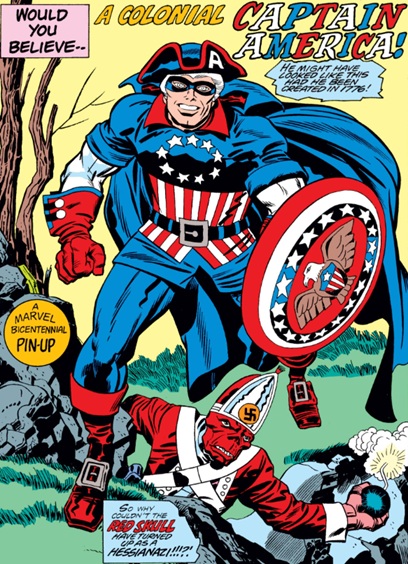
Captain America of the Revolutionary War should
be distinguished from:
 images:
(without ads)
images:
(without ads)All-New Official Handbook of the Marvel Universe A to Z: Update#4 (December, 2007) - Jeff Christiansen (head writer/coordinator), Sean McQuaid, Michael Hoskin, Stuart Vandal, Chris Biggs, Al Sjoerdsma, Mark O'English, Mike Fichera, Ronald Byrd, Chad Anderson, David Wiltfong, Eric J. Moreels, Madison Carter & Anthony Flamini (writers), Brian Overton (copy editor),John Denning & Cory Levine (assistant editors), Mark D. Beazley (associate editor), Jeff Youngquist & Jennifer Grunwald (editors)s
Official Handbook of the Marvel Universe A to Z hardcover#3 (July, 2008) - Jeff Christiansen (head writer/coordinator), Madison Carter, Mike Fichera & Stuart Vandal (coordination assistants), Sean McQuaid, Stuart Vandal, Ronald Byrd, Michael Hoskin, Eric J. Moreels, Madison Carter, Mark O'English, Mike Fichera, Al Sjoerdsma, Chad Anderson, David Wiltfong, Chris Biggs, Jacob Rougemont, Rich Green & Gabe Shechter (writers), Brian Overton (copy editor), John Denning & Cory Levine (assistant editors), Mark D. Beazley (editor, special projects), Jeff Youngquist & Jennifer Grunwald (editor)
Ruins of Ravencroft: Sabretooth#1 (March, 2020) - Frank Tieri (writer), Guillermo Sanna (artist for flashbacks), Danny Khazem (assistant editor), Devin Lewis (editor)First posted: 09/02/2026
Last updated: 08/21/2026
Any Additions/Corrections? please let me know.
Non-Marvel
Copyright info
All other characters mentioned or pictured are ™ and � 1941-2099
Marvel Characters, Inc. All Rights Reserved. If you like this stuff, you
should check out the real thing!
Please visit The Marvel Official Site at: http://www.marvel.com
Special Thanks to www.g-mart.com for hosting the Appendix, Master List, etc.!
 .
.
 (Captain America: Sentinel
of Liberty#6/3 (fb) - BTS /
(Captain America: Sentinel
of Liberty#6/3 (fb) - BTS /