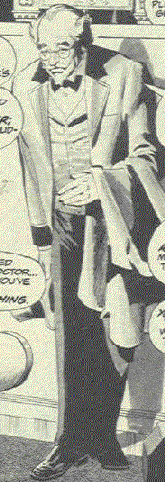
 ABRAHAM VAN HELSING
ABRAHAM VAN HELSING
Real Name: Abraham van Helsing
Identity/Class: Human, 19th century
Occupation: Vampire hunter, anthropology professor
Group Membership: Vampire Hunters
Affiliations: Ally of Jonathan Harker,
Jack Seward, Arthur Holmwood, Mina Murray, Quincy Harker;
Frank Drake, Taj Nital, Rachel van Helsing
Enemies: Dracula, Children of Judas, Lucy Westernra, Lyza Strang
Known Relatives: Boris van Helsing (brother, deceased), Elizabeth van
Helsing (wife, deceased), Mrs. van Helsing (second wife,
deceased), unidentified son (deceased), Abraham van Helsing (son, see comments; deceased), Eveline O'Reilly (nee van Helsing; presumptive granddaughter) and her apparent daughter or granddaughter, unidentified grandson (deceased),
Mrs. van Helsing (granddaughter-in-law, deceased), Rachel van
Helsing (great-granddaughter, deceased)
Mr. van Helsing (Rache's father), Rache van Helsing, Hans, Mr. van Helsing (Rache & Hans' son) (ancestors);
Jeremiah van Helsing, August van Helsing
(distant relations), Noah Tremayne (distant relations via adoption)
Aliases: Herr Dekter van Helsing, Professor van Helsing, Baron of Bistritz
Base of Operations: 19th Century Europe
First Appearance: (Historical) Dracula
(1897);
(Marvel) Tomb of Dracula I#1 (April, 1972)
Powers/Abilities: Van Helsing possessed no superhuman abilities. He had a vast understanding of vampire lore, and was adept in the use of weapons used against them.
History: (Dracula Lives#3/text (fb)) - Abraham van Helsing was a Dutch professor who taught, at various times, at the University of Leyden, Trinity College, and Oxford University. He taught anthropology and philosophy (secular and religious). In Paris once, he read a book by Augustin Calmet about vampires.
(Dracula Lives#3/text) - A few days after
marrying a woman named Elizabeth, lawyers informed van Helsing
that he had inherited land from a distant relative in Wallachia.
Traveling to Romania, van Helsing had a long conference with
some lawyers in Bistritz. Elizabeth went ahead to the manor to set
it up for the night.
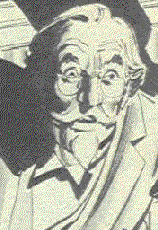
One lawyer whom van Helsing talked to had a collection of Hun and Magyar artifacts, and van Helsing lost track of the time studying them. When he arrived at the manor, he found his wife missing, but did discover several corpses with XXX burned underneath bite marks on their necks. Armed with a gun from his brother Boris, who lived in the U.S., Harker frantically left.
Returning to Bistritz, a frenzied van Helsing discovered the existence of the Children of Judas, a vampire coven that served Dracula. He also discovered the location of the Grand Sabbath of the vampires (Van Helsing assumed that the Children of Judas were human, but mentally ill occultists). He went there, and found Elizabeth bound on an altar surrounded by Dracula and thirteen Children of Judas.
Van Helsing opened fire with normal bullets, only to see them have no effect. Stunned, only the arrival of a group of priests and soldiers saved him, but not Elizabeth. Van Helsing refused to allow Elizabeth’s corpse to be beheaded or staked. Reluctantly, they allowed van Helsing to bury Elizabeth in the manorial vault, but they informed him of what to do in three days.
Standing watch in the vault, van Helsing saw her return as a vampire. Destroying her, he swore revenge against Dracula.
(Tomb of Dracula I#30 (fb)) - In 1862, Dracula was persuaded by Lyza Strang, the wife of a political rival of Otto von Bismarck, to murder her husband so that Bismarck, whom she had fallen in love with, would become Chancellor of Prussia. After Dracula killed her husband, he also killed Lyza, who returned as a vampire under his control. Abraham van Helsing destroyed Lyza Strang.
(Legion of Monsters#1/Tomb of Dracula I#7 (fb)) - In 1890, Dracula, having acquired ownership of England’s Carfax Abbey through solicitor Jonathan Harker, moved to the abbey, and began menacing England. His victims included Lucy Westernra in Whitby. The aristocrat had suitors such as Jack Seward, Arthur Holmwood, and Quincey Morris, as well as a friend in Mina Murray, Jonathan Harker’s fiancée. Jack Seward, who worked as a doctor in an asylum, tending to among others, the notorious Renfield, contacted van Helsing about Lucy Westernra’s peculiar loss of blood.
(Stoker's Dracula#2-3) - Van Helsing, recognizing the mark of the vampire, tried to save Lucy, but she died, returning as a vampire. Eventually, van Helsing destroyed the vampiric Lucy.
(Stoker's Dracula#4) - Van Helsing pursued Dracula back to Transylvania. Quincey Morris and Jonathan Harker, armed with knives, impaled Dracula through the heart and apparently decapitated him. Seeing his body evaporate, they left, assuming him to be destroyed.
BTS - However, since the knives they used were not made of wood or silver, they did not hurt Dracula as they thought. Instead, Dracula, using his ability to turn into mist, tricked them into thinking that they had destroyed him, and when they left, he returned to corporeal form.
(Tomb of Dracula I#1 (fb), Tomb of Dracula I#2 - BTS) - At some later point in time, van Helsing traced Dracula back to his castle, due to the assistance of a young boy named Carl von Harbou. Although von Harbou served Dracula, he decided to betray his master to van Helsing.
Finding Dracula in his coffin, van Helsing drove a stake through Dracula’s heart.
(Tomb of Dracula I#5) - In the 21st century, Dracula, having undergone many deaths and returns over the years since his struggles with van Helsing, traveled back in time to the 19th century via an enchanted mirror, attempting to prevent his destruction at the hands of van Helsing. Instead of arriving before the staking, however, he arrived after, but still tried to kill van Helsing. However, van Helsing had left the area of the Borgo Pass and Castle Dracula.
Dracula killed a young woman, and villagers stormed Castle Dracula. Dracula repulsed them, after which he discovered that Frank Drake, one of his descendants, and Rachel van Helsing, Abraham's great-granddaughter, had followed him from the 21st century. Determined to destroy Abraham van Helsing, Dracula had a subordinate vampire named Lenore battle Drake and Rachel as he sought to find Abraham van Helsing.
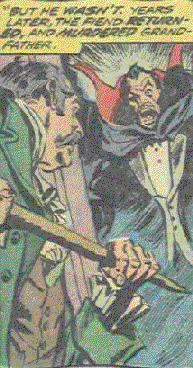 Dracula discovered
Abraham van Helsing’s lodgings elsewhere in Romania. Stunned
and confused as he had just driven the stake through (the native
temporal counterpart of) Dracula’s heart a short time ago, van Helsing was unprepared to face the 21st century Dracula.
However, Rachel van Helsing saved her great-grandfather, forcing
Dracula to flee. Dracula escaped back into the timestream, with
Frank Drake, Rachel van Helsing, and their ally Taj Nital in
pursuit.
Dracula discovered
Abraham van Helsing’s lodgings elsewhere in Romania. Stunned
and confused as he had just driven the stake through (the native
temporal counterpart of) Dracula’s heart a short time ago, van Helsing was unprepared to face the 21st century Dracula.
However, Rachel van Helsing saved her great-grandfather, forcing
Dracula to flee. Dracula escaped back into the timestream, with
Frank Drake, Rachel van Helsing, and their ally Taj Nital in
pursuit.
(Tomb of Dracula I#7 (fb)) - Abraham van Helsing trained Mina and Jonathan Harker’s son, Quincy, in vampire lore.
(X-Men: Apocalypse vs. Dracula#1 (fb) - BTS) - Dracula began vampirizing members of London's Clan Akkaba, the descendents of Apocalypse. One of the Clan, Jack Starsmore (apparently, part of the local constabulary) investigated the killings.
(X-Men: Apocalypse vs. Dracula#2 (fb)) - Abraham van Helsing, drawn by the
nature of the "killings," tracked down Jack Starsmore and revealed Dracula's
involvement. Starsmore brought van Helsing to meet Apocalypse and the rest of
the Clan. Having had some past experience with an Egyptian race of vampires,
Apocalypse believed van Helsing and agreed to accompany him to the morgue. There
they were confronted by the now fully vampirized Clan Akkaba members, whom they
destroyed.
Meanwhile, Slade brought Dracula to Alexandria House, Clan
Akkaba's base, and instructed his mother, Margaret Slade, to come meet his new
guest.
(X-Men: Apocalypse vs. Dracula#3 (fb) - BTS) - Dracula vampirized the rest of Clan Akkaba, with the exception of Margaret Slade, plus Jack Starsmore and Frederick Ferguson, who had accompanied Apocalypse.
(X-Men: Apocalypse vs. Dracula#3 (fb)) - Slade and the rest of the vampirized Clan Akkaba ambushed Apocalypse, van Helsing, Jack Starsmore, and Frederick Ferguson as they returned to Clan Akkaba. Ferguson teleported himself and his allies to safety; the vampires soon tracked them down and attacked again, but the vampires were destroyed by the dawn of the new day. Apocalypse, however, was bitten by one of the vampires during the conflict. Dracula returned to his Transylvanian Castle.
(X-Men: Apocalypse vs. Dracula#4 (fb)) - As Apocalypse, van Helsing, Jack Starsmore, and Frederick Ferguson approached, Dracula sent his human and vampire legions after them. Via his vampire bite, Dracula tracked down and his foes, sending rats, bats, and wolves against them. As their underlings fought, Apocalypse confronted Dracula in his castle, but the vampire bite rendered Apocalypse susceptible to Dracula's control. Dracula prepared to vampirize Apocalypse, but then van Helsing threw holy water in Dracula's face. Apocalypse took advantage of Dracula's weakness, skewering him through the heart and then decapitating him. However, Apocalypse refused to follow van Helsing's orders any further and left the body without a permanent stake in its heart or without burning its body.
(Tomb of Dracula I#20 (fb)/Tomb of Dracula II#3/2) - <1899> Van Helsing, thinking that by staking Dracula he had destroyed him for good, received a rude surprise when Dracula returned years later and killed him.
(Tomb of Dracula I#40 (fb)) - Eventually, Abraham's great-granddaughter Rachel continued where he had left off, trained by Quincy Harker in combating vampires.
Comments: Created by Bram Stoker; adapted by Gerry Conway and Gene Colan.
Tomb of Dracula I#1 and #5 pretty much implied that Dracula had been staked and an inanimate corpse since the end of the 19th century before the foolish Clifton Graves pulled the stake out of his heart and inadvertently revived him in Tomb of Dracula I#1. This is why Dracula in issue #5 was depicted going back to prevent his destruction at the hand of Abraham van Helsing; Gardener Fox, who wrote that issue, went with the notion that it had been Dracula’s last destruction, and so that would be the one Dracula would be eager to go back in time to prevent.
However, when Marv Wolfman took over Tomb of
Dracula, he stated in the letter columns that Dracula had only
been an inanimate corpse for a few years before Clifton Graves
accidentally revived him. He depicted this in Tomb of Dracula
I#15, which revealed that Dracula had been staked by a Scotsman
whose son had been killed fighting vampires in India (The son
had served as an agent of Quincy Harker, and did not become a vampire
as Dracula wounded but did not bite him). Not only that story,
but Tomb of Dracula I#33, which showed Dracula had attacked
Quincy Harker at the Royal Opera House in London at some point
after World War II, and even Invaders I#9, which established that
Dracula had murdered John Falsworth, the future Baron Blood, in
1914, cemented the idea that Dracula had not been an inanimate
corpse since the early part of the 20th century, but had
been active throughout those years. In fact, Marvel Comics
Presents#77-79 even did a story where the Howling Commandos met
Dracula during World War II!
That story, by the way, established
that Percy of the Howling Commandos knew "A" van Helsing.
As regards von Harbou, he first appeared in
Tomb of Dracula I#2. We saw him as an old man, at least sixty,
whom Dracula confronted, reminding him of how von Harbou served
him as a young boy. Von Harbou having become a doctor since last
seeing Dracula, helped Dracula by fixing up his skin, which had
turned chalk white due to his having been an inanimate skeleton
for too long. Dracula then killed von Harbou calling him
"The very boy who betrayed me to my killers!" Since
Conway probably had the destruction of Dracula by stake at van
Helsing’s hand from issue#1 in mind, I presume that he
intended that von Harbou had betrayed Dracula to van Helsing that
time.
hmmm...that gets harder to buy with the
sliding time scale. That idea might have worked out in the early 1970s,
but not in the 21st century, where von Harbou would now have to
have been over 100 years old at the time of Tomb of Dracula
I#2--Snood.
As regards Legion of Monsters#1, that story was part of an intended in-depth adaptation of Stoker’s novel, which continued in various issues of Dracula Lives#5-8, 10, 11-12 and even in Legion of Monsters#1, without getting through half the book. Marv Wolfman has stated that, had he finished the adaptation, he would have handled Dracula’s getting killed by Jonathan Harker and Quincey Morris with knives as happened in the novel by stating that it didn’t "take" due to the knives not being of wood or silver. He admits that he took this idea from the Fred Saberhagen novel The Dracula Tapes. That novel, which had Dracula narrate his run-in with Jonathan Harker and the rest from his point of view into a tape recorder, had it that Dracula used his ability to turn into mist to make his enemies think that they had killed him. Once they left, he returned to solid form.
Incidentally, as noted under the entry for Lord
Ruthven, the events of Dracula's battle
with Harker and van Helsing were embellished by Bram Stoker in
the Marvel Universe -- which explains why Dracula was shown
walking around in the daytime in the novel, although in the
Marvel Universe he cannot. Dracula Lives!#12 even showed the
Marvel Universe Bram Stoker stealing Dracula's diary!
--Actually, it had Stoker receiving the
novel, which had been stolen by Durenyi, back in 1597--Snood.
I fit in that flashback from Tomb of Dracula
I#1 with van Helsing staking Dracula as happening at some point
after this, for the reasons given. I will note that, due to the
Marvel rules on time travel, the appearance of Abraham van
Helsing in Tomb of Dracula I#5 serves technically as an
appearance of an alternate reality version of him, as Marvel
Two-In One#50 and elsewhere establish that time traveling
usually produces an alternate reality. However, I left that out
of the history due its being a bit too complicated to discuss.
Again, I assume that the writer had the destruction of Dracula
briefly shown in Tomb of Dracula#1 by van Helsing in mind, hence
my slotting of the time travel story in #5 after that.
--That time travel policy is by far in the minority of time travel
exaples, and I would not consider it any kind of policy.--Snood
Dracula Lives#3 featured a prose text story "I Was Once a Gentlemen" by Chris Claremont which detailed the origin of van Helsing. Once again, Claremont slightly ran afoul of Dracula continuity, as the story is told in the from of a diary entry by van Helsing dated February 5, 1876, with van Helsing noting that his wife died a few days ago. Tomb of Dracula I#30’s Bismarck story makes it clear that van Helsing had become a vampire hunter by the 1860’s, as the story took place in 1862. However, other than the date (you try getting the year right after destroying your wife, who had returned as a vampire, you wouldn’t remember what year it was AD, BC, or after the Hegira. I see no serious reason to exclude this text story. Hell, Night Raven’s entry mostly deals with text stories!
In Marvel Comics Presents#79, Percival Pinkerton of the Howling Commandos vowed to inform Abraham van
Helsing of Dracula's whereabouts. This story took place in July,
1942, and Abraham's death is given as before 1900 in Tomb of
Dracula II#3/2. The best way I can think of to explain this would
be to assume that Abraham's son was also named Abraham. It's also
reasonable to assume he might have been a vampire hunter, and
that it was he of which Pinkerton spoke. Why not?
--Snood.
On that same note, in Bizarre
Adventures II#1/3, Eveline O'Reilly notes herself to be the daughter of
Abraham van Helsing. As the story takes place just before World War II,
which started in 1939, it seems hard to believe that she could be the
son of a man
who died in 1900 (and whose wife was insane, but still his legal and
moral wife circa 1890). Thus, I am fairly confident that Evaline would
be the daughter of Abraham, son of Abraham.
As the sliding timescale
marches on, even that is a little problematic, not so much for Evaline,
but for existing relationship. If Evaline is 20-30 circa 1939 and her
father is grandfather of Rachel van Helsing, it seems a stretch for
Evaline to be the aunt of Rachel who seemed to be about 30 in the
modern age of Marvel. Certainly it is possible to have siblings be 20
or more years apart, and so it is not unreasonable, but I think Rachel
will eventually become Abraham's great-great-granddaughter
The van Helsings were foes of Dracula as far back as 1465, just six years after he became a vampire:
Rachel van Helsing first appeared in Tomb of Dracula I#3. Her origin was fleshed out in Tomb of Dracula I#40. Her father and grandfather’s names have yet to be revealed, although her father and mother have been depicted. I will presume that Abraham van Helsing married again after the destruction of his vampirized wife Elisabeth, as the text story in Dracula Lives#3 noted that they were married for a few days while before Elizabeth became a vampire. That way, Rachel’s grandfather would have been a child of Abraham’s hypothetical second wife.
In any event, Rachel later became a vampire herself, but allowed Wolverine to destroy her in X-Men Annual#6. She returned -- in spirit only -- in Tomb of Dracula III#1. Marv Wolfman, incidentally, said he disliked how Chris Claremont killed her, in an interview.
Rachel received an entry in OHOTMUDE.
There is some confusion regarding her
being Abraham's granddaughter or great-granddaughter. I suspect
that when the stories were first written, in the early 1970s,
they made her out as his granddaughter--and as Marvel's timescale
slid further forward, they decided she was too young to be tied
that closely to someone from the 19th Century, so they made her
his great-granddaughter. I'd have to go back and recheck all of
the original issues, which I'm not going to do--but YOU
can!--Snood.
Quincy Harker first appeared in Stoker’s novel on the last page. Marv Wolfman adapted him to the Marvel Universe in Tomb of Dracula I#7, which included a partial origin. Tomb of Dracula I#33 features additional origin information on him. He died in Tomb of Dracula I#70, and received an entry in OHOTMUDE.
Finally, I strongly recommend this Tomb of Dracula site for more information on the Tomb of Dracula series.
Ronald Byrd offers some other van Helsing facts:
by John McDonagh, with updates by Snood.
Clarifications:
Abraham van Helsing should be distinguished from:
images: (without ads)
Tomb of Dracula I#1 (April, 1972) - Gerry Conway (writer), Gene Colan (artist), Stan Lee (editor)
Tomb of Dracula I#2 (May, 1972) - Gerry Conway (writer), Gene Colan (pencils), Vince Colletta (inks), Stan Lee (editor)
Tomb of Dracula I#5 (November, 1972) - Gardner F. Fox (writer), Gene Colan (pencils), Tom Palmer (inks), Roy Thomas (editor)
Tomb of Dracula I#7 (March, 1973) - Marv Wolfman (writer), Gene Colan (pencils), Tom Palmer (inks), Roy Thomas (editor)
Tomb of Dracula I#20 (May, 1974) - Marv Wolfman (writer), Gene Colan (pencils), Tom Palmer (inks), Roy Thomas (editor)
Tomb of Dracula I#30 (March, 1975) - Marv Wolfman (writer), Gene Colan (pencils), Tom Palmer (inks), Len Wein (editor)
Tomb of Dracula I#40 (January, 1976) - Marv Wolfman (writer/editor), Gene Colan (pencils), Tom Palmer (inks)
Legion of Monsters#1 (September, 1975) - Roy Thomas (writer), Dick Giordano (artist), Tony Isabella (editor)
Dracula Lives#3 (October, 1973) - Chris Claremont (writer)
Tomb of Dracula II#3 (February, 1980)
Stoker's Dracula#2-4 (February-May, 2005) - Roy Thomas (writer), Dick Giordano (artist)
X-Men: Apocalypse vs. Dracula#1-4 (April-July, 2006) - by Frank Tieri
(writer), Clay Henry (penciler), Mark Morales (inker), Mike Marts
(editor)
First posted:
06/11/2002
Last updated:
09/25/2022
Any Additions/Corrections? please let me know.
All characters mentioned or pictured are
™ and © 1941-2099 Marvel Characters, Inc. All Rights
Reserved. If you like this stuff, you should check out the real
thing!
Please visit The Marvel Official Site at: http://www.marvel.com