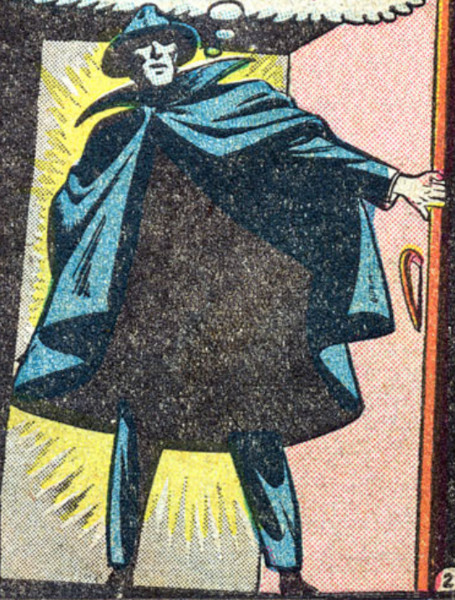
 Real Name: Unrevealed - may be the Witness
WITNESS
Real Name: Unrevealed - may be the Witness
Identity/Class: Unrevealed - a ghost or similar seems likely (Post-World War II era)
Occupation: Observer, radio host
Group Membership: None
Affiliations: Joe Jameson, unidentified ghost
Enemies: None
Known Relatives: None
Aliases: None
Base of Operations: Performed his radio show out of the Standard Broadcasting Corporation Studios, but mobile worldwide.
First Appearance: The Witness#1 (September 1948)
Powers/Abilities: The Witness is invisible to living humans, though ghosts can see him, and people can still hear his voice, at least when he chooses. He can also address specific individuals, so that they do not actually hear his words but are still influenced subconsciously by what he says. He appears to be insubstantial under normal circumstances, but can touch things when he chooses to. He can read people's thoughts, and though not seem to overtly act or even make his presence known, he claimed he "brought fear and trembling to those whose ways are evil." He can follow anyone he chooses, no matter how they might attempt to evade pursuit, and teleport thousands of miles in an instance to switch between people whose fates were intertwined. He can also predict potential futures, seeing multiple options out to their conclusions depending on the choices individuals make. He may also be able to project images of what he observes, including these potential futures, into the minds of the people he tells his stories to (or he might just be speaking figuratively when he says he is going to show the reader the events).
Height: Unrevealed
Weight: Unrevealed (possibly inapplicable)
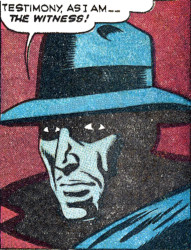
Eyes: Blue
Hair: Unrevealed
 History:
(Witness#1 (fb) - BTS) - The Witness was a spectral man seemingly drawn
to observe strange incidents. Invisible to all but the dead, and
apparently insubstantial unless he willed otherwise, the Witness could
still be heard by living humans, and so he would recount tales of the
things he had seen in live radio broadcasts made from the Standard
Broadcasting Corporation Studios, though most of his listeners
considered the claims that nobody at the studio--not the staff nor the
live audiences--could see the Witness. The very human announcer who
introduced the program was Joe Jameson, a career-focused man who tended
to ignore his wife Claire's concerns over their newborn son while he was
busy with the show.
(Witness#1/2 (fb) - BTS) - The Witness claimed to see and
hear everything, even the thoughts in people's minds, and to bring fear
and trembling to those whose ways were evil.
(Witness#1 (fb)) - One night, while wandering through the city planning the next night's broadcast, the Witness was tapped on the shoulder by a stranger. Initially surprised that someone had seen him, when he turned the reason became clear, as his new acquaintance was clearly a ghost. He listened as the ghost explained he had once been an extremely rich and successful businessman, wanting for nothing...except that he was lonely and unloved, without even a single friend; however this didn't concern him, since his only goal had been power, his only love money, and he didn't care how many people he destroyed to get them. Then he died, only to find no peace in his grave. His soul rose from his coffin, compelled to trod the Earth with no rest, never to close his eyes, never to sleep, seeking a single tear from just one human who would weep for him and regret his death; but he found there was not one person in the entire world who wept for him, nor even cared that he was dead. He was doomed to wander the Earth forever, exhausted but unable to ever rest, unable to speak to a single soul, to find a friend, to ever rest, until someone would weep for him, just shed one single tear.
(Witness#1 (fb) - BTS) - Having
told his tale to the Witness, the spirit went on his way, returning to
his quest.
 (Witness#1)
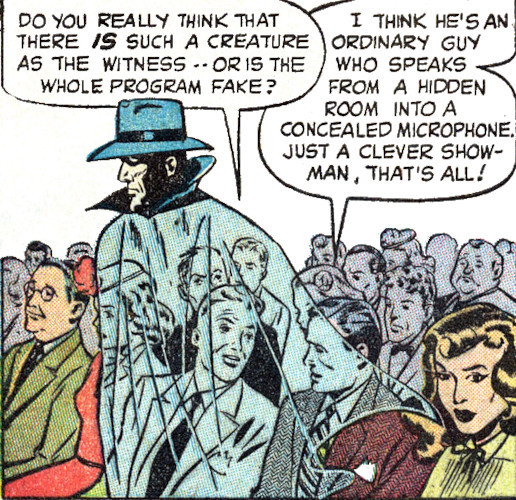
- The next night, the Witness arrived at the Standard Broadcasting
Studios mere moments before his show was due to start, but for the
first time he hesitated before he entered. As a result, the show
announcer had to begin the show without the Witness being present, and
played for time by getting the orchestra to perform. Hearing this, the
Witness entered and slipped through the live audience unnoticed to
reach the stage, where he tapped Jameson on the shoulder and informed
the man of his arrival. Relieved that the show could proceed, Jameson
announced his intention to leave and grab a drink, but the Witness
told him to stay, saying this night's story might be of particular
interest to him. To the crowd, it appeared Jameson was talking to
himself, but then the Witness moved to the microphone and began
talking. Despite his voice seeming to come from nowhere, many in the
audience remained convinced it was merely a trick and he was speaking
via a hidden mike in another room. The Witness began his tale by
admitting he was late because he had considered not sharing the story,
considering it a case so weird that it might be better to remain
untold; but he relented because it was a case that should make
everyone reconsider their own lives, and it could happen to any of
them. Then, before starting his tale, he asked a question - had they
ever met a dead man? He proceeded to recall his encounter of the
previous night, at first spooking and then tugging on the audience's
heartstrings with his account of the ghost's plight. Hearing the tale,
Jameson shed a tear for the dead man, and miles away in a cemetery,
the ghost realized the Witness had somehow released him, and lay down
for a final rest. Spotting Jameson about to slip out of the studio,
the Witness called to him, asking whether he intended to sign off the
program, but Jameson told the Witness that he should do it, since the
story had made him realize how he had neglected his family, and he was
determined to start making it up to them immediately. With Jameson
having left, the Witness returned to the microphone and asked his
listeners if the program had also helped open their eyes, noting that
he didn't know the answer, since he was only the Witness, while the
audience was the judge.
(Witness#1/2 (fb)) - The Witness observed unnoticed as
wealthy New York businessman Robert Hammer had his lawyer, Collins,
inform Hammer's two junior partners, Paul Murray and Dean Nye, of the
terms of Hammer's will, leaving them a bond worth one million dollars in
the event of Hammer's demise, in the hope it would "bring them both the
reward they richly deserved." In a macabre twist of fate, Hammer then
immediately suffered a heart attack and died in front of them. Murry and
Nye made a pretense of grieving, but the Witness saw in their thoughts
that all they cared about was the money. The pair immediately asked
Collins when they could cash the bond, but Collins, who expressed
disgust at their avarice and sadness that they had tricked Hammer into
trusting them, told them the bond could be waiting for them in the same
office in exactly one month. As Murray and Dean departed with open glee,
the Witness opined that anyone should be satisfied with 500 thousand
dollars apiece, but noted that the groundwork for a monstrous turn of
circumstances was already being laid, since while the two men acted
friendly to each other, their thoughts betrayed the hope in each that
the other would die so he could inherit the full amount. To understand
Murray's reasons, the Witness followed him and observed as some thugs
working for an underworld figure known as the Big Guy intercepted him
for failing to repay a half million dollar gambling debt, and then
forcibly take him to their employer. When Murray desperately promised
he'd settle his bill, the Bug Guy demanded to know where he thought he'd
get so much money from, and Murray made the mistake of mentioning the
bond. Hearing that there was a million up for grabs, the Big Guy
declared that there was now interest owed, and demanded the entire
amount. Terrified of the promised agony that would be inflicted on him
if he didn't deliver, Murray agreed, which the Witness noted meant
Murray would now have to kill Nye. Switching his focus, the Witness
began spying on Nye, who was with his ambitious girlfriend, Elena
Thornton. Having been told of the bond, she pressured Nye into promising
to secure the full amount, thus sealing a second murder pact.
The Witness continued to monitor both
men for the next month as they fretted over what they would have to do,
constantly reminded by their respective instigators. Finally the month
ended, and both men were informed over the phone by Collins that to
claim the bond, they were both to go to Hammer's office at midnight.
Standing outside the building, the Witness watched them both arrive at
the same time shortly before the deadline, and enter the building
together. Murray suddenly made a dash for the self-service elevator, and
the moment Nye put one foot inside, he hit the button to close the door.
However, though the door slammed shut with deadly speed, Nye narrowly
made it inside without being caught, and Murray passed off the attempt
as an accident caused by nerves. Reaching the high floor the office was
on, Nye then pretended to trip in order to "accidentally" bump into
Murray, intending to knock him through a full-length window, but it
turned out to be unbreakable glass. As Murray got back to his feet, the
two men looked at one another, and the Witness could see into their
minds to confirm they had both suddenly realized the other man was also
planning murder. Racing down the hall in an attempt to reach the bond
first, the two men began grappling once they reached the office, a fight
that ended with Nye being thrown out the window to fall to his death.
(Witness#1/2) - As Nye plummeted, the Witness watched Murray look at the bond on the desk and a note accompanying it, then stagger over to the window muttering "It can't be" over and over, and jump out the window to his death. Talking to an unseen audience (see comments) the Witness told the story of the two ill-fated men, then went over to the desk to reveal why Murray had ended his own life despite having "won" the bond. The accompanying note was from the late Hammer, and read "Knowing my junior partners as I do and trusting neither, I have added this precaution against my money being wasted. This bond is worthless unless the valid signatures of BOTH men are signed and notarized." Thus the two inheritors' greed had doomed them both, for in trying to claim all of the money for themselves by eliminating the other recipient, they had guaranteed that neither would get a single cent. Once he learned this, Murray had committed suicide rather than face torture at the Bug Guy's hands.
(Witness#1/3 (fb)) - The Witness observed George Murday,
a man engaged to the beautiful Betty Grogan, but who the Witness knew
from reading George's thoughts was really only interested in her
father's wealth. While the Witness looked on, Betty's father interrupted
the pair while they were dancing to speak to his daughter, and she
returned to inform George the terrible news that her father's
million-dollar business had just gone bankrupt. Trying to stay positive,
Betty promised him that they could still get married, but George
immediately broke off the engagement, telling the shocked Betty outright
that he'd only been after the money, then walked away, leaving her
heartbroken.
(Witness#1/3) - The Witness watched as
George drove his car down a quiet highway, seeking to put distance
between himself and the life he was now fleeing. Coming to a
crossroads, he stopped the car, unsure which branch to take, overtaken
by indecision, but sure of one thing, that he was not going to turn
back and return to face the music for his callous actions. Talking to
his unseen audience, the Witness stated he would show what awaited
George depending on which path he chose.
If George took the right hand
fork, he would soon reach a town where almost immediately he would
catch the eye of a rich and beautiful woman named Rita Sanburn. Not
only would she make the first move to approach him, but they would
enjoy a whirlwind romance, with George genuinely falling in love with
her. They would soon become engaged, with Rita making it clear that
she didn't expect George to have to work to support them, since she
had more than enough money for both of them. An equally swift wedding
followed; but after a lavish honeymoon, reality abruptly set in, as
George discovered Rita was selfish and vain, and she and her equally
snobbish friends all looked down on him. When George finally tried to
stand up for himself, Rita announced she never wanted to see him
again, and George, never able to handle things not going his way, fled
the marriage, blaming everyone but himself.
If George took the left hand fork, he would soon be caught in a heavy storm and then drive by a young woman called Susan. Stopping to pick her up, the pair swiftly hit it off; genuinely falling in love with her, George decided to take the risk of marrying her despite neither having much money, but with George believing she'd change his luck for the better. A pattern in Susan's behavior would begin to emerge - having lived all her life on chances that never came through, she now wanted to only ever make the safe, secure choices -- thus she would convince him to take a low-paying but steady book-keeping job, rather than hold out for a better job to come along. Her constant need to play it safe began to weigh on him. Soon after, George would be told about a stock tip, a company whose share price was about to rapidly rise. Deciding to take the risk, George wrote a check to invest heavily, and soon afterwards the stocks shot up in price as promised. Elated, George told Susan they were now rich, only for her to confess that she'd stopped the check without telling him, afraid they might have lost their savings if the prices didn't rise. Unable to cope, George would handle this the same way he handled every set back -- he would run away, blaming everyone but himself for his misfortunes.
Finishing the second account,
the Witness stated that neither path forward would work out for
George, because it was neither fate nor luck that shaped his destiny,
but his own habit of fleeing at the first sign of any misfortune. The
Witness noted that the only way George could break this pattern and
change his destiny would be to turn around and go back to repair the
damage he had done in the past, but that way was closed to him as well
by his own choice, and so George would continue on, his future forever
futile.
 (Ideal#4/2) - Recounting the story of the Great
Vargas Diamond, the Witness entered the offices of diamond dealer George
Frazier Putnam, who was in the middle of brokering a deal. The Witness
informed his unseen audience that thousands of miles away, two
simple-minded Brazilian peasants, Carlos and Manoel, were going to be
involved in events that would shape Putnam's fortunes. Instantly
traveling to their location, the Witness watched the pair narrowly avoid
being hit by a car; having never seen such a vehicle before, Manoel
immediately decided he had to have one, and when Carlos told him that
such things were expensive, Manoel announced they would "hunt" diamonds;
when Carlos rebuffed this idea, pointing out that diamonds were not
hunted but mined, Manoel insisted that he had heard such things could be
found mixed among the rocks in shallow rivers. While the Witness
tirelessly watched, the pair diligently spent the next two months
searching from dawn until dusk in the shallows of the San Antonio River,
until Manoel by sheer chance actually discovered an extremely large
diamond...only to immediately dismiss it as a large pebble because he'd
never seen a diamond before and didn't actually know what they looked
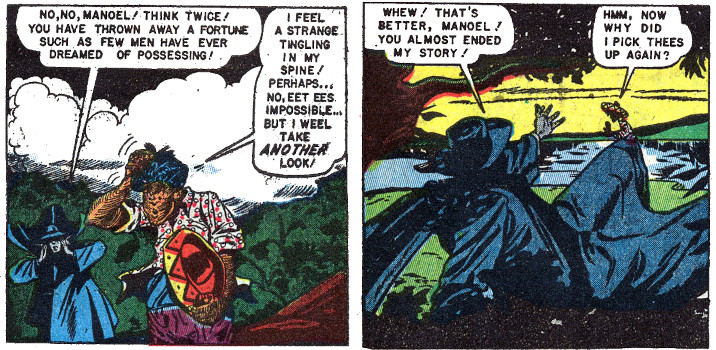
like. He threw it away, nearly ending the Witness' tale there, so the
spectral observer hastily called out to Manoel, telling him rethink his
decision. Subconsciously sensing rather than hearing his words, Manoel
picked the diamond back up, though he was confused why he had done so.
Then as he rubbed it against his trousers to clean it and the sunlight
struck it, he finally realized he was holding a diamond.
Word rapidly spread across the world that two
South American peasants had stumbled across a 726 carat diamond, the
second largest in the world. Terrified it might ruin the diamond market
if it fell into the wrong hands, diamond syndicates around the world
hastily sent representatives to acquire the stone before anyone else
did. The Witness watched as a bidding war began, which was largely lost
on the two peasants, since the bidders were offering large dollar
amounts to men who only understood pesos. Eventually they sold it to a
Dutch syndicate for a fraction of its actual worth, plus a big car.
Putnam arrived to find he was too late to purchase it from them; but
determined not to lose out, he flew to the Netherlands and bought it
from the dealer for a reasonable price after convincing them there was
no one else in the world but him who could cut it to achieve its maximum
worth. The Witness watched as he took his prize to London to hire the
finest craftsmen in the world to cut the gem, observing this it took
them a year to do so, until finally it was ready, and was sold to a
wealthy dowager who kept it in a vault, only exhibited on special
occasions to a handful of extremely snobbish people. Finishing his
account, the Witness confirmed what had happened to Carlos and Manoel;
they lived high for a year, crashed their car and got sued (something
they didn't really understand), and between taxes and chiselers, they
were soon broke again. The Witness watched as the pair rode down the
road on their burros, penniless but happy, unaware that long after they
died and were forgotten, the diamond they had found would continue to
awe and astound mankind.
(Captain America Comics#71/4) - Promising his unseen
audience a tale of sordid crime and the boxing ring, the Witness walked
backstage at the boxing ring due to host a bout between Dusty Mangler
and Sid Brophy, heading to the former's dressing room, where Dusty and
his manager Cha-Cha were telling two bookies that Dusty would not take a
dive...for less than $4000. However, when the bookies turned that down
and were about to leave, Cha-Cha suddenly dropped the price to $3500.
Once the bookies left, the Witness watched as Dusty bemoaned his
dropping price, noting that after fifteen years they were beginning to
count him out for good; Cha-Cha responded that he was good for at least
another ten years, and the Witness mused that ten more years would make
a record, giving Dusty a quarter century of fights without a single
honest bout among them. However, as he walked through the booing crowds
to the ring, hearing them call him "Feet-First Mangler," Dusty began to
have second thoughts, opining to Cha-Cha that maybe he shouldn't throw
this fight. However Cha-Cha reminded him that double-crossing the
bookies would get him killed. As the fight progressed, the Witness noted
that Dusty was thinking back through his career, unable to recall a
single honestly won match. Deciding that losing another match by fouling
his opponent would end his career permanently, Dusty chose to instead
take a beating so he could be counted out by the referee. As the referee
counted to ten, Dusty lay on the mat, promising himself this was the
last fight he'd throw, and that he'd play it smart from now on. However,
once he was lying on the table back in his dressing room, the Witness
announced that Dusty wasn't capable of playing it smart, and like all
crooks, he was too dumb, thinking he was stringing the world along when
it was only himself he was fooling. He told Cha-Cha he was going to
fight straight from now on, and wanted to eventually build himself up
until he got a shot at the title. However, as soon as he left the arena,
Dusty headed to a bar, with the Witness noting that the boxer's
punch-drunk brain was already hatching a new scheme. Dusty decided he'd
rebuild his reputation with a string of easy fights that he would win,
then when he stepped into the ring with the odds favoring himself, he'd
secretly bet everything on his opponent, throw the fight, and retire on
his winnings. The Witness continued to observe as Dusty proceeded with
the first step of this plan, winning a series of honest fights. At first
Cha-Cha thought it had to be that Dusty's opponents were just pushovers,
but as the Witness noted, the wins kept coming even when Cha-Cha set up
bouts with serious contenders. Eventually, even Cha-Cha believed Dusty
had become a winner, and arranged a fight with top boxer in his
division; meanwhile, having saved sufficient money for a good sized bet,
and with excellent odds to quadruple his money, Dusty decided it was
time to throw his final fight. Since he had no intention of winning,
Dusty made no effort to train, and the Witness watched as Cha-Cha grew
increasingly frustrated at his fighter's sudden lackadaisical attitude.
When fight night finally came around, the Witness was in Dusty's
dressing room observing as the fighter asked Cha-Cha why he was suddenly
no longer complaining about him not taking the fight seriously, to which
Cha-Cha responded that he'd given up worrying. For three rounds, the
Witness watched as Dusty struggled against his opponent, but then in the
fourth round, just before his intended dive, Dusty struck his rival a
light punch for show, only for the man to collapse and be counted out.
To his despair, Dusty was announced the winner, and he returned to his
dressing room, realizing he was ruined, all his savings wiped out.
Jubilant, Cha-Cha admitted to Dusty that since the boxer hadn't been
training well, he'd paid Dusty's opponent to take a dive; but hearing
that, Dusty called him an idiot, informing the manager of betting
against himself, but adding that he'd been so sure of the fight he'd
also bet all of Cha-Cha's savings. As Dusty laughed hysterically and
Cha-Cha sobbed, the Witness concluded that the only purse to be won by
crookedness was a purse full of misery and regrets.
 (Amazing Mysteries#32/3 (fb)) - The Witness
watched as Charles Redmont met Jeannie Lockhart at a seasonal dance, and
after he made the first move, they began a couple of months of dating.
However, when she stood him up at a restaurant without so much as a
call, Redmont grew angry and headed over to her department to confront
her. The Witness knew the reason was because Jeannie was ill and had
passed out. When Charlie arrived at her department, he ran into the
doctor leaving and confronted Jeannie about her visitor, refusing to
believe her explanation and storming off, unaware the confrontation had
triggered her collapse and hospitalization. Charlie went out and played
the field in an attempt to forget Jeannie, not knowing that Jeanie had
been in the hospital until the physicians released her to a convalescent
home, not because she was getting better, but because unless a miracle
occurred, she had less than ten months to live. Meanwhile Charlie
finally realized he couldn't forget Jeannie and went to visit her,
hoping to win her back. Hearing him confess his love, she broke down and
told him about her sickness, but when she informed him she was going to
stay at the doctor's place in the country, he immediately jumped
straight back to the assumption that she was lying to him and actually
dating the doctor. Extremely hurt by the accusations, Jeannie demanded
he leave and never return. As he left, Charlie decided he had to do
something to remove Jeannie's voice from his head once and for all, so
he decided to kill her, and covertly left her door unlocked when he went
out. He began by preparing his alibi, making a point of talking to
various people on his way home to ensure they would remember him and
when he had encountered them. Unaware the Witness was watching
everything, Charlie then waited at the boarding house where he stayed,
counting the minutes until he was sure all the other residents had gone
to sleep and no one would see him slip back out through a rear entrance.
Despite his plans, he immediately ran into a musician returning to the
boarding house heavily drunk, but despite this setback, Charlie decided
to continue, hoping the boozer wouldn't recall anything, and aware his
opportunity would be lost once Jeannie left for the country the next
day.
(Amazing Mysteries#32/3) - At 2 AM, the
Witness watched as Charlie slipped through a back alley hugging a
wall, and the observer began to recount his tale to his unseen
audience, recapping prior events before continuing with current
events, as Charlie slipped into Jeannie's apartment building. Despite
some close calls with residents still up at the late hour, Charlie
managed to reach Jeannie's room unseen and slipped in, saw Jeannie
lying motionless and face down in bed, and shot her. He made a dash
for the exit, intending to get out before anyone could respond to the
shot, but before he reached the door, it was flung open by Jeannie's
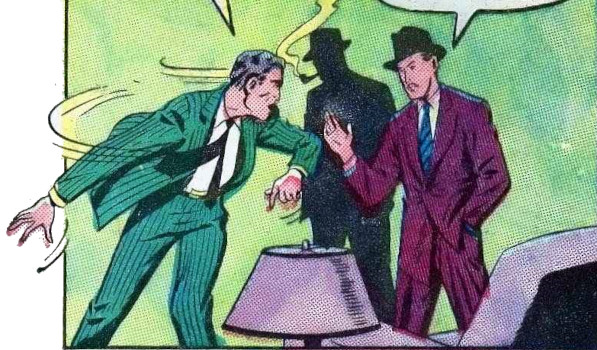
doctor. With the Witness a mere shadow on the wall, smoking a pipe as
he watched, he observed as Charlie admitted his crime since he'd been
caught red-handed, but the man was unrepentant, stating that even the
electric chair would be better than constantly imagining Jeannie's
face all the time, and seeing the doctor's arrival at this late hour
as confirmation of his suspicions about her affair with the man.
However, realizing who Charlie was, the doctor informed him he'd not
actually killed Jeannie. Charlie railed at this claim, still convinced
he was being lied to, but the doctor explained that the confrontation
earlier in the night had brought on another attack. Jeannie had
managed to call the physician, but by the time he got there, she was
already dead, over four hours before Charlie slipped in and shot her
corpse. The doctor informed Charlie that the one thing that might have
helped Jeannie live longer was his love, but he'd refused to give it.
Finally realizing Jeannie had not been two-timing him and had been
telling the truth all along, Charlie was overcome with remorse, asking
the world in general what had he done. Listening, the Witness stated
that Charlie had done almost nothing in a legal sense, being merely
guilty of intent to kill, but he wouldn't want to live with Charlie's
conscience, as he'd have to live the rest of his life with regret over
what he'd tried to do.
(Captain America Comics#72/2) - The Witness told the story
of research chemist John Sheldon, a brilliant man and a dreamer who
hoped the world would profit from his work. He was convinced there was
an unknown element, Element X, the life element that would provide the
missing link between the animate and inanimate. When the university cut
his funding, he sold his home, cashed in his insurance, all so he could
continue his work; but after years of failure, he seemed no closer to
discovering his prize. One day, tired and hungry, he left his
experiments despite being sure he was finally close, because he needed
to eat something. Observed by the Witness, he went to the club where his
former colleagues congregated, intending to get some food there; but
when he ran into the other scientists, they began to ridicule him for
his obsession. With their mockery ringing in his ears, John ran back to
his cellar laboratory, only to discover that in his absence ,the
experiment he had left running had finally produced Element X. Watching
John's revelation, the Witness declared him a true scientist, whose
elation was swiftly subdued as John methodically double-checked his
calculations, realizing that Element X had 1000 times the power of
atomic fission, and that if he added just a single drop of Chemical Y to
Element X, it would trigger a chain reaction, producing the most
devastating explosive power the world had ever seen. However John was
determined his discovery should only ever be a boon to mankind, as it
could rid the world of disease, cause better crops, thus eliminating
hunger and poverty, and allow mankind to enter a golden age. The Witness
urged John to dream on, saying he deserved those dreams, having given
all he possessed to create a better world, telling him to dream on
because reality was about to intrude. As the Witness watched, two
sinister looking men entered John's lab and revealed themselves to be
Communists sent by their government to buy all John's notes and work.
John informed them he didn't plan to sell his formula, since it was for
the betterment of the world, then naively admitted he had discovered
Element X, but added that it included destructive powers, so he could
not provide it to just one country. Immediately, the two men began
beating John up, demanding he show them the formula or be killed. Now
realizing that the world would use Element X for destruction, John
decided to play along with the spies, and promised to show them. As they
watched, he added Chemical Y to his small amount of Element X, with the
Witness urging him on, saying that if they wanted to possess the power
of destruction, they should see how it worked. And with that, the
mixture exploded, killing both the spies and John, who sacrificed his
life to ensure his discovery didn't fall into the wrong hands. The
Witness observed as John's fellow scientists later searched through the
remains of the lab, assuming John had accidentally mixed the wrong
chemicals, and deeming that he had died as he had live, a failure.
Hearing this, the Witness admitted that John had indeed been a failure,
but only because he failed to realize the world was not yet ready for
his discovery. And the spectral observer opined that one day Element X
might be rediscovered, and wondered if the world would be ready for it
then.
(Marvel Mystery Comics#92/2) - The Witness told the tale
John Whittier, starting when he was but a boy rushing home, ignoring his
friends' attempt to get him to play ball with them because he wanted to
study. All his life, he had a goal of great wealth and a dream of power;
born on the wrong side of the tracks, he'd become determined at a young
age to one day take his place among the great men of wealth and power,
and to this end he studied hard all through college. The Witness
followed John as he became a Wall Street runner by day, while studying
the financial sheets at night. Watching as Whittier had letters
inscribed in the window of his new investment broker office, the Witness
noted that John had no friends, nor did he accumulate any good memories,
instead still only seeking wealth and power. In time, through shrewd
manipulation and ruthlessness, John became one of the wealthiest men in
the world, able enough to have power over entire nations. Then one day,
John's private plane crashed as he was racing between cities. He
survived, waking to find himself on a rural farm near where his plane
had come down, because the doctor had said he should not be moved.
Forced into inaction for the first time in his life, John found his
convalescence surprisingly pleasant thanks to the company of the
farmer's daughter, Verna Stoddard, and in time they fell in love.
However, when he proposed, she turned him down, telling him she couldn't
live his kind of life, as she believed since people only lived once,
they should use their life for leisure, thought and play, close to
nature. John eventually returned to the city, but found his zest for
schemes of empire had gone. Instead, he constantly envisioned Verna's
face and recalled her philosophy. The Witness watched John as the
financier stood in his office brooding, looking out over the city, much
of which he owned, and finally coming to a decision. John gave away
almost all his wealth to charities, keeping only enough to purchase a
farm, and then got married to Verna, unaware the Witness was in
attendance at the ceremony standing right behind the couple. Places such
as the UN were filled with individuals who couldn't believe John had
given up all his power to become a simple farmer, but the Witness could
confirm it, covertly observing as John and his two sons finished their
chores and went fishing. His tale ended, the Witness asked his invisible
audience what their take was - was John a fool to give up so much, or
perhaps the wisest man of all? He could not render an opinion, for they
should be the judge, while he was but the Witness.
Comments: Created by unidentified individuals, as the story carried no credits.
For a very long time, many comic texts and
then latterly online sites conflated this character with the other
Timely Comics Witness.
However, once scans of the relevant issues for each character allowed
more people to read the actual stories, it became very clear they are
distinct and unrelated characters. It also looks very likely this
character inspired Mark
Gruenwald's Witness
character in the New Universe, as visually they are both fairly similar.
Only in his first story do we actually see
him telling his tales to a living audience, but in each story he still
recounts what he has observed to unseen viewers. Obviously this is a
fairly common conceit of the horror host type characters - they usually
break the fourth wall when regaling the readers. In universe, it may be
that he's somehow transmitting his tale to the radio station despite not
being physically there (in as much as he's ever physically anywhere,
given he's usually insubstantial), or perhaps like She-Hulk, Blonde
Phantom and Deadpool he's aware of the comic readers, or heck, maybe
he's even telling some other unseen observer (the Watcher?)
about what he has seen.
Given his apparently spectral nature, there's
no reason to believe he couldn't still be active in the modern day.
The story with Manoel and Carlos is somewhat
confused, as it establishes the two men live in Brazil, but then
portrays them as Mexican, since the only money they know of are pesos.
Even if they were both originally Mexican, the tale confirms that
they've never seen (or in Manoel's case, even heard about) cars before,
and really know nothing about the wider world, which would be hard to
reconcile with people who had traveled over 4000 miles between countries
on two different continents.
In a couple of his tales, the Witness smokes
a pipe, though naturally no one present notices the smell.
The Witness' skin color shifted from story to
story. Mostly he was a pale blue, but on a few occasions he was a
similarly pale of-white, and in his final story he was suddenly
pink-skined.
This profile was completed on 09/23/2026, but its publication was delayed as it was intended for the Appendix 25th anniversary's celebratory event to represent the Witness.
Perhaps the creators of The Witness were
inspired by The
Shadow, who was originally created in 1930 to only be the
narrator of the radio series "Detective Story Hour"; but the
character proved to be so popular that it was expanded to become a
pulp magazine character in 1931.
Maybe The Witness had some connection
with the mysterious Man
in Black who encountered Lurton
Gaxton.--Ron Fredricks
Profile by Loki.
CLARIFICATIONS:
The Witness has no known connections to:
images: (without ads)
The Witness#1, p2, pan7 (main image)
The Witness#1/2, p2, pan3 (headshot)
The Witness#1, p3, pan1 (walking invisibly through crowd)
Ideal#4/2, p4, pan5-6 (speaking to Manoel)
Amazing Mysteries#32/3, p9, pan5 (Witness as a shadow on the wall,
smoking a pipe)
Appearances:
The Witness#1 (September 1948)
- Stan Lee (editor), no other
credits
Ideal#4/2 (January 1949) - Gene Colan
(unconfirmed as penciller)
Captain America Comics#71/4 (March 1949) - Stan Lee (editor), no other
credits
Amazing Mysteries#32/3 (May 1949) - Stan
Lee (editor), no other credits
Captain America Comics#72/2 (May 1949) - Stan Lee (editor, unconfirmed
as writer), no other credits
Marvel Mystery Comics#92/2 (June 1949) - Mike Sekowsky (pencils), Stan
Lee (editor)
First Posted: 09/25/2026
Last updated: 09/23/2026
Any Additions/Corrections? please let me know.
Non-Marvel
Copyright
info
All other characters mentioned or pictured are ™ and © 1941-2099
Marvel Characters, Inc. All Rights Reserved. If you like this stuff, you
should check out the real thing!
Please visit The Marvel Official Site at: http://www.marvel.com
Special Thanks to www.g-mart.com for hosting the Appendix, Master List, etc.!