 WINNIPEG
 WINNIPEG
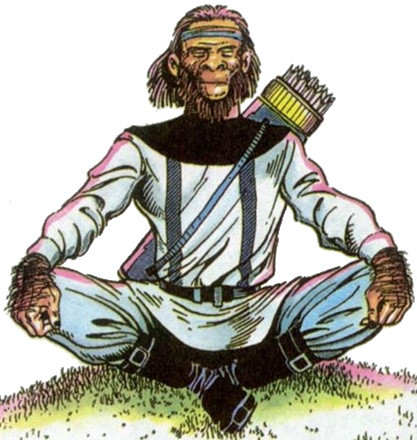
Real Name: Winnipeg
Identity/Class: Alternate Reality (possibly Earth-7481; see comments) human
Occupation: Presumably hunter, trapper, forager and
mystic
Group Membership: Lightfeet
Affiliations: His spirit is bonded with
Packer's;
Bart, Heston, Roto;
(spirit combined with Packer's)
Alexander, Caesar (aka the Lawgiver)
Enemies: Combined
Ape/Tectonese/human army under the leadership of Ollo, Danada, and Simon
the Slaughterer;
(spirit combined with Packer's) The Governor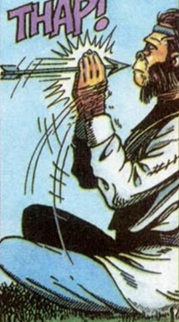
Known Relatives: None
Aliases: None
Base of Operations: Unrevealed;
at least formerly the mountains outside of Ape City
First Appearance: Ape Nation#1 (February, 1991)
Powers/Abilities: A spiritual being, Winnipeg
possessed a form of prescience/precognition.
He could enter a deep trance, dreaming of events and
people of significance to him and what the future may hold for them.
Like the rest of the, Lightfeet, Winnipeg was an expert tracker, and he was in tune with events, the land, people and the environment around him.
Winnipeg was an expert combatant and
marksman with bow and arrow.
History:
 (Ape Nation#1 (fb) - BTS) - On the future Earth
where Apes took over the planet (see
comments), Winnipeg was a member of the Lightfeet, a tribe of
apes with spiritual connection to the land and who were well-known to be
the best trackers.
(Ape Nation#1 (fb) - BTS) - On the future Earth
where Apes took over the planet (see
comments), Winnipeg was a member of the Lightfeet, a tribe of
apes with spiritual connection to the land and who were well-known to be
the best trackers.
(Planet of the Apes#23 (fb) - BTS) - The Lightfeet were "the
night
stalkers, the quiet walkers, keepers of the neverending scrolls, writers
of the history of the world. Speakers of the ancient tongue, they delved
into the mysteries of their world."
(Ape Nation#1 (fb) - BTS) <"Not long" before the main story> - Heston of Ape City encountered Winnipeg and had a positive interaction.
(Ape Nation#1 (fb) - BTS / Ape Nation#2 (fb) - BTS) - A Tenctonese ship commanded by Caan used a black hole to travel across time and space (and likely across realities) to arrive on the planet of the Apes. There, Caan's brother, Danada, led a revolt that
overwhelmed and imprisoned Caan and his followers (including Elysa and
Pascha) so that they could instead serve as conquerors of this planet.
(Ape Nation#1 - BTS) - Following reports of the arrival of the aliens,
Heston of Ape City was instructed to choose a small party to accompany
him. Heston first chose Packer, who carried an abundance of supplies.
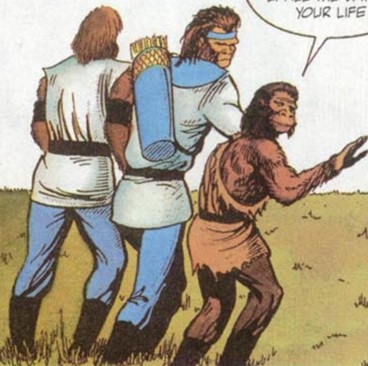
(Ape Nation#1) - The next morning, Heston led Packer to Winnipeg. As
Winnipeg sat in meditation atop a hill, Packer commented that he looked
dead. Heston replied that he had heard about the Lightfoot tradition of
going into a deep trance and that some said that it helped the Lightfeet
see into the future.
Picking up Winnipeg's bow, Packer fired an arrow, but
his lack of experience sent it straight toward Winnipeg, whose arms
reached up and caught the arrow an inch from his face. Winnipeg then told
Heston that he knew of his quest, and -- while reclaiming his bow from
Packer -- he shared that he had seen the face of the newcomers (see
comments) in his dreams. He further advised them that though he
feared that it would bring pain and death, that he lead Heston to them. 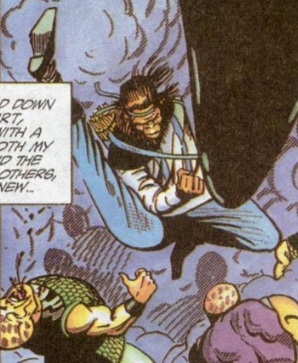
(Ape Nation#1 - BTS) - Heston further recruited the powerhouse brawler Roto and accepted the request to join the party from Council-member Jacob's son, Bart.
(Ape Nation#1 - BTS) - Danada joined forces with the ape General Ollo and the human Simon the Slaughterer, who led an army of their combined forces to conquer Earth.
(Ape Nation#1 (fb) - BTS) - Winnipeg led Bart, Heston, Packer and Roto in tracking the aliens.
(Ape Nation#1) - After six weeks, Packer noted that they had not seen
anything out of the ordinary, but Heston advised that they were still
pretty far from where the travelers had spotted the alien ship.
Feeling vibrations on the ground, Winnipeg stated
"they are coming," and they soon appreciated a pack of charging deathhogs.
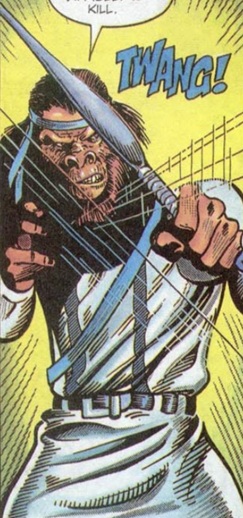
Firing an arrow, Winnipegadvised the others to strike deep, as they were
difficult to kill.
While the group slew the deathhogs, Bart fled, but he
soon returned, fleeing in the other direction, and Winnipeg then pointed
out the approaching combined forces army, informing his allies that this
is what he had seen in his dreams.
As there was not time to relocate, Winnipeg ant the
others stood and fought, vastly outnumbered. Although Winnipeg cut down
his opponents with the slightest of movements and Rotore tore through
their attackers, they were inevitably overwhelmed.
Packer went down first, and then one of the Tectonese
dropped Winnipeg with a club to the back of his head. Roto was eventually
dragged to the ground, and Heston was captured.
(Ape Nation#2 (fb) - BTS) - Roto somehow escaped capture, as did Bart, who had fled before the arrival of the combined forces.
(Ape Nation#4 (fb) - BTS) - Winnipeg and Packer were captured and brought
aboard the Tectonese ship. With Packer dying, Winnipeg sacrificed his own
life, sending his spirit into Packer, saving him. Both men's spirits
thusly lived on in Packer.
(Ape Nation#2-4 - BTS) - Heston joined forces with Caan and his sister
Elysa, eventually reuniting with Roto and Bart, who led reinforcements,
which were further aided by the Lightfeet. Between that and internal
strife amongst the combined forces, the combined forces fell apart, and
Caan reclaimed command of the Tectonese.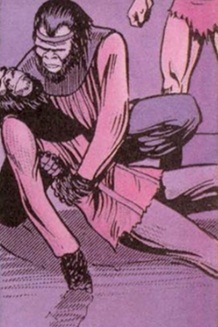
Comments: Created by Charles Marshall and M.C. Wyman.
Winnipeg and the
Lightfeet are most likely intended to be like the indigenous tribes of
the Americas.
Winnipeg is almost certainly named after the Canadian
province:
Winnipeg is the capital and largest city of the Canadian province of Manitoba. It is centred on the confluence of the Red and Assiniboine rivers. As of 2021, Winnipeg had a city population of 749,607 and a metropolitan population of 834,677 and a metropolitan population of 834,678, making it Canada's sixth-largest city and eighth-largest metropolitan area.
The city is named after the nearby Lake Winnipeg; the name "Winnipeg" comes from the Western Cree words for "muddy water" – winipīhk. The region was a trading centre for Indigenous peoples long before the arrival of Europeans; it is the traditional territory of the Anishinaabe (Ojibway), Ininew (Cree), Oji-Cree, Dene, and Dakota, and is the birthplace of the Métis Nation. French traders built the first fort, Fort Rouge, on the site in 1738. A settlement was later founded by the Selkirk settlers of the Red River Colony in 1812, the nucleus of which was incorporated as the City of Winnipeg in 1873.
In the Alien Nation movie/stories, the Tectonese were commonly referred to as the Newcomers.
Heston was obviously
named as an homage to Charlton Heston (born John Charles Carter), who
starred in the original Planet of the Apes movie, amongst many others.
Caan was obviously named as an homage to actor James
Caan, who starred as the human veteran police investigator, Matthew
Sykes, who was partner to a Tenctonese police officer, named Sam
Francisco, whom Sykes called George (played by Mandy Patinkin, whom you
hopefully know as Inigo Montoya, "You
killed my father...prepare to die," from The Princess Bride).
The Planet of the
Apes reality in Marvel Comics was designated as Earth-7481 in the
Official Handbook of the Marvel Universe A to Z#3's appendix to
Alternate Earths, with a first appearance listed as Planet of the Apes
#1 (1974). That reality is the home reality of Apeslayer
(who first appeared in the UK's Planet of the Apes#23 (1975)), and when
I wrote that profile, I was convinced that it was not the same reality
as the Planet of the Apes stories, but based on discussions with Loki, I
am not so sure.
Loki said (in response to my queries):
The original premise is based on a French novel, La planète
des singes (literally The Planet of the Monkeys)
by Pierre Boulle, though there are some significant differences
between it and the movie.
Marvel's Planet of the Apes Magazine#11 includes a timeline which places all the movies up to that time (so, the original five), the TV series and the Marvel comics (barring Apeslayer, simply because the American writer probably didn't know it even existed) in a single timeline. Makes sense, since the comics were intended to be based on the world seen in the movies, and the TV series was likewise. But then it immediately suggests that there might be multiple timelines, since movie#3 (Escape from) starts with three apes traveling back in time to the 1970s, and they potentially change their own history - specifically the time-traveling apes inform the humans they encounter about how apes supposedly started speaking and rose up against humanity - a gorilla named Aldo some 200 years in the future - only for the subsequent movies to show the son of the time travelers to lead a rebellion only 20 years later, and apes starting to speak at that juncture. So they might have diverged a new timeline, but it might also simply be that the apes in Escape, who hailed from the 3900s, had their facts wrong - how accurately do we know events from the first century A.D.?
Rich Handley's Timeline of the Planet of the Apes covers all movies, TV series, novels and comics to the date of its publication, 2009, and manages to put everything in a single timeline - but he also acknowledges there are some contradictions (movie#3 has the apes claiming dogs and cats will be wiped out by plague in the near future, and movie#4 goes along with this, showing the aftermath, but the TV series and the comics have shown cats and dogs still around centuries later - but if we again allow for the apes having somewhat inaccurate knowledge of their distant past, and for the plague only wiping out the majority of cats and dogs, we can get round this too). Handley obviously didn't include anything from the new movies, since they had yet to be created, nor more recent comics, so contradictions might arise there.
Handley also cites three other timelines, not counting the one from PotA Mag#11.
—
“The Planet of the Apes—A Chronological
History” (Dayton Ward, in Paul A.
Woods’ The Planet of the Apes Chronicles) -
includes everything, including comics, in a single timeline.
— Planet of the Apes Timeline (20th Century Fox,
Widescreen 35th Anniversary Edition DVD) - only bothers
with the movies, but puts it all in a single timeline
— Planet of the Apes Timeline (Peter Ventrella
and Gavin Howell, 40th Anniversary Collection) - only bothers
with the movies, and puts them in two timelines,
with the divergence caused by the time-traveling in
Escape.
At the end of the day, we don't have to worry
about the novels, newer movies, etc. We only have to figure out
if the regular Marvel issues are in the same or
different realities from Apeslayer, and if the Malibu
issues are in the same or different realities from
both of those. Given that most of these timelines seem
to feel that they could all be one timeline, and our default tends to
be "all in the same timeline unless there is good reason to
believe otherwise", I am leaning towards ASSuming that
all the all these comic tales share a single reality, and
since we've already designated Apeslayer as 7481, that's
probably the reality for the other Marvel stories,
and the Malibu ones.
Me/Snood:
I don't think Apeslayer is the same reality
as Planet of the Apes.
In Apeslayer, there are
alien apes from another world (Mars) coming to Earth and
conquering humanity.
I
thought Planet of the Apes was an
uprising of the apes on Earth conquering humanity?
Loki again: Whether it was the original run or the newer movies, the apes gain human level intellect and rise up, and humanity falls and loses its ability to speak and much of its sentience.
It is worth noting that this doesn't make things utterly incompatible for Apeslayer to be part of the same reality; that's why most of those timelines I cited still include it. As the Handley book shows, the events of Apeslayer happen centuries after the initial rise of the apes and the Malibu comics, and over a thousand years before the events of the original movie and most of the Marvel comics. Humanity doesn't fall completely overnight - indeed, sentient humans are still around in the far future period of the original movies, just in isolated, usually hidden pockets. So them still being around for the extraterrestrial apes to conquer circa Apeslayer's era isn't a dealbreaker, nor is the apparent absence of sentient Earth apes, who might simply be active in other regions of the planet. Having alien apes invade while terrestrial apes are also ascending elsewhere on the globe is somewhat implausible, but then so is alien apes conquering Earth to begin with.
The original novel was released in 1963 (can't find a specific date or even month), the first English-language edition was November 1964, the original movie came out April 3rd, 1968, and Marvel's series began in August 1974. Malibu's Planet of the Apes started in April 1990.
Snood again: Based on all of that, I don't think there is any reason to provide a designation for anything beyond the pre-existing Apeslayer reality designation, which apparently includes the Planet of the Apes comics by Marvel, at least, and presumably the pre-existing movies, at least.
This profile was
completed 02/02/2026, but
its publication was delayed as it was intended for the Appendix 25th
anniversary 's celebratory event.
Profile by Snood.
CLARIFICATIONS:
Winnipeg should be distinguished from:
First posted: 09/21/2026
Last updated: 02/02/2026
Any Additions/Corrections? please let me know.
Non-Marvel
Copyright info
All other characters mentioned or pictured are ™ and © 1941-2099
Marvel Characters, Inc. All Rights Reserved. If you like this stuff, you
should check out the real thing!
Please visit The Marvel Official Site at: http://www.marvel.com
Special Thanks to www.g-mart.com for hosting the Appendix, Master List, etc.!