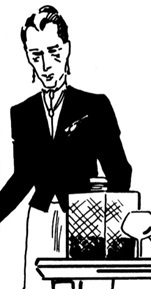
 HEIDI
CARGAISON
HEIDI
CARGAISON HEIDI
CARGAISON
Real Name: Heidi
Cargaison
Identity/Class: Human;
active circa 1930
A.D. (and likely at least 40-50+ years before that)
Occupation: Journalist
Group Membership: Los Angeles
Tribune
Affiliations: None known
Enemies: Calvin Beck, Carmilla (Mircalla Karnstein), Harry Cohn,
Max Nodurft, Georges Orly, Hjalmar
Polezig, Vitus Verdegast, Patty
Mei Wong;
indirectly Owen Vincent "Owney" Madden (she
was cowed into submission by a warning against crossing him)
Known Relatives: None
Aliases: None
Base of Operations: Hollywood, California;
formerly an unspecified portion of Europe
First Appearance: Carmilla#5 (June, 1991)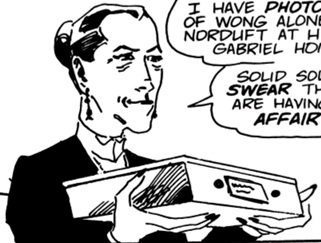
Powers/Abilities: Heidi Cargaison was an experienced journalist dealing with Hollywood figures.
She is apparently racist, notably against Asians but likely against any other people on non-European origin (and perhaps some of various European nations, as well).
History:
(Carmilla#5 (fb) - BTS) - Heidi Cargaison
immigrated to the USA at some point.
(Carmilla#5 (fb) - BTS) - Heidi
Cargaison was a Hollywood columnist employed by the Los Angeles Tribune.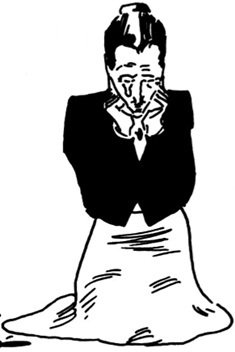
Under unrevealed circumstances, she learned that Max
Nodurft, who was directing the Cosmopolitan Studios movie adaptation
of Joseph Sheridan Le Fanu's Carmilla, was living with his lover, Patty Mei Wong. Disapproving of this relation between a man of
European (German) descent and an Asian woman, she met with producer Vitus Verdegast. After hearing her complaints, Vitus had Max
summoned to his office, and Heidi informed him of her concerns.
(Carmilla#5) - Max considered the complaint
preposterous as his personal life was nobody's business but his own, but Heidiargued
that
as a Hollywood columnist, it was her business. She further suggested that
perhaps Max was too young to recall the necessity of the Chinese Exclusion
Act of 1882, and Max informed her that he hadn't even immigrated to
America until 1926. Vitus further added that both he and Heidi were
immigrants, while Patti Mei Wong was born in the USA. Heidi told Vitus not
to be naive as they were European while Wong was Asian and that it was
illegal for "her kind to marry ours."
Heidi then turned to Max and added, "But,
of course, you and Miss Wong are only living in sin, aren't you?"
Calvin Beck, apparently an agent to the stars,
interjected that Patty was a talented actress, whether Heidi cared to
admit it or not, but he could rarely give her work. He further noted that
theaters in England and France adulated Asian and Negro talent, while
Americans like her degraded them. 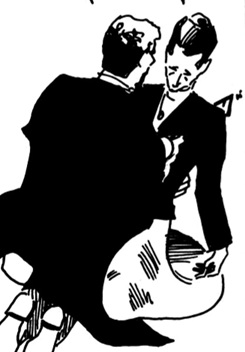
Heidi bluntly shared that she had photographs of Wong alone with Nordurft at his San Gabriel home and that solid sources swore that the two were having an affair. She then warned that the days Carmilla debuted, her gossip column would be brimming with this evidence and that the careers of Beck, Verdegast, Nordurft and Wong would be over, unless, of course, Max terminated "this disgusting relationship."
Refusing to allow this, Max quit and stormed out, and Vitus sent Beck to calm him down while he dealt with Heidi. Vitus subsequently told her that he had been waiting a long time for her to screw up like this, and that while he could tolerate most gossip columnists, she was not just stupid but mean. He swore that if she printed that evidence, before the evening's night owl edition hit the streets, she would be dead. Heidi advised him that Harry Cohn (co-founder and president of Columbia Pictures) threatened her life once, and she was still alive. Vitus, in turn, advised her that Cosmopolitan Studios had Owney Madden as one of its principal stockholders, and he suggested that threatening the fortunes of the most powerful gangster in Harlem should scare the piss out of her.
(Carmilla#5 (fb) - BTS) - Sarah Karnstein, the actress playing the vampire Carmilla, was actually the 17th Century vampire from the 19th Century novella Carmilla, and she sent her associate Hjalmar Polezig to kill Heidi Cargaison. He entered Heidi's apartment undetected and drank her (presumably) brandy while he waited.
Returning to her apartment, Heidi was incensed when the doorman told her he trusted she had a pleasant day, and she vowed that she would have his job. As she turned her liquor table, she noticed a missing glass and that the bottle was half empty. When she exclaimed, "What the devil is going on?!," Hjalmar replied, "'The Devil,' precisely, Miss Cargaison."
Shocked, she dropped the bottle and
asked who he was and what he wanted. Hjalmar introduced himself, and she
begged him that he could take whatever he wanted but to please not hurt
her. Apologizing and revealing his right sword hand (it looked like he
might have a prosthesis, and an actual sword in place of his hand),
Hjalmar told her that hurting her was the sole purpose of his
visit.Dropping to her knees, she begged him not to do this, but he
advised her that she had brought this on herself: "You
are full of wrath and rancor; now the time has come -- to pay the
devil his due!" 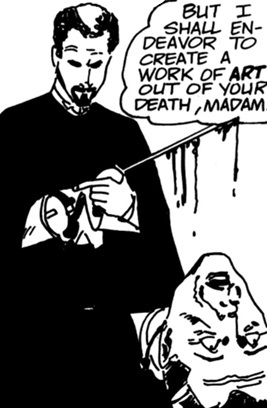
After stabbing her through the chest,
Hjalmar told her that dying was easy, but that dying memorably was
difficult. He told her that he would endeavor to create a work of art
out of her death: "A grand guignol of
blood -- and bone -- and flesh!"
(Carmilla#5) - Hjalmar slew and likely mutilated Heidi Cargaison.
Comments: Created by Steven Jones and John Ross under Aircel Comics, a division of Malibu Graphics Publishing Group. File this one under "Holy
Crap, here's a whole level of legalized racism of which I was not aware!"
Obviously times were different, but this is really hard to believe. But, I
looked at a number of apparently solid websites, including legality.org
and asiasociety.org,
and everything back this up. Feel free to look it up, and I'd really like
it if someone could prove to me that this isn't actually true:
In the United States, interracial marriage, cohabitation and sex have been termed "miscegenation" since the term was coined in 1863. Contemporary usage of the term is infrequent, except in reference to historical laws which banned the practice. Anti-miscegenation laws were first introduced in North America by the governments of several of the Thirteen Colonies from the late seventeenth century onward, and subsequently, they were introduced by the governments of many U.S. states and U.S. territories and they remained in force in many US states until 1967.
California’s first legislature passed a law in 1850 that prohibited marriages between white people and “negroes or mulattoes,” (mulatto being an antiquated and bigoted term for people of mixed African/black and "white" ethnicity...originally derived from the word mule, a crossbreed of a horse and a donkey--Snood) with criminal penalties for anyone who entered into or performed such a marriage. The ban was narrower than the original article suggests. It did not initially cover people of Asian or Native American descent. Those expansions came later.
In 1872,
the legislature dropped the criminal penalties but kept the prohibition in
place through Civil Code Section 60, which declared all marriages between
white people and “negroes or mulattoes” illegal and void. Section 69
barred county clerks from issuing licenses for those marriages. Then the
ban widened: in 1880 and 1905, the legislature amended both sections to
add “Mongolians” (a term then used for people of Chinese, Japanese, and
other East Asian descent). In 1933, after a court ruled that Filipinos did
not fall under the “Mongolian” category, legislators quickly added
“Malays” to the list. Each amendment reflected who lawmakers perceived as
a threat to the racial hierarchy at a given moment, not any consistent
legal principle.
In 1948, California was the first state in the country to strike down a law banning interracial marriage, doing so nearly two decades before the U.S. Supreme Court addressed the issue nationally. The 1948 California Supreme Court decision in Perez v. Sharp invalidated the state’s nearly century-old prohibition and set a legal precedent that rippled across the country. That ruling, the civil rights legislation it inspired, and the eventual federal protections that followed make California’s history with interracial marriage laws one of the most consequential in American legal history.
In 1967, in the landmark case Loving v. Virginia, the remaining anti-miscegenation laws were ruled unconstitutional by the U.S. Supreme Court under Chief Justice Earl Warren.
Cargaison is apparently a French word
meaning cargo. Heidi seems like more of a German name, so maybe she is
of German and French origins?
Vitus Verdegast and Hjalmar Polezig were apparently
at least named after characters from the 1934 movie "The Black Cat,"
played by Bela Lugosi and Boris Karloff, respectively.
Harry Cohn and Owney Madden were real people. You can
Google them for more information.
Courtesy of Loki, who suggested
covering Mrs. Cargaison to represent Carmilla for the 25th Anniversary:
The first three issues are
based on the early vampire novel Carmilla (and I think adapt
it), while the next three are a sequel tale.
Not tied to anything else from Malibu AFAIK, nor is there anything to
render the series inconsistent with Earth-616.
Surprisingly, despite integrating many of the iconic vampires from 19th
century fiction, if even only for passing mentions in JML's vampire
histories, Carmilla hasn't shown up in any Marvel comic that I know
of.
This profile was
completed 04/17/2026, but
its publication was delayed as it was intended for the Appendix 25th
anniversary 's celebratory event.
Profile by Snood.
CLARIFICATIONS:
Heidi Cargaison should be distinguished from:
First posted: 09/21/2026
Last updated: 04/17/2026
Any Additions/Corrections? please let me know.
Non-Marvel
Copyright info
All other characters mentioned or pictured are ™ and © 1941-2099
Marvel Characters, Inc. All Rights Reserved. If you like this stuff, you
should check out the real thing!
Please visit The Marvel Official Site at: http://www.marvel.com
Special Thanks to www.g-mart.com for hosting the Appendix, Master List, etc.!